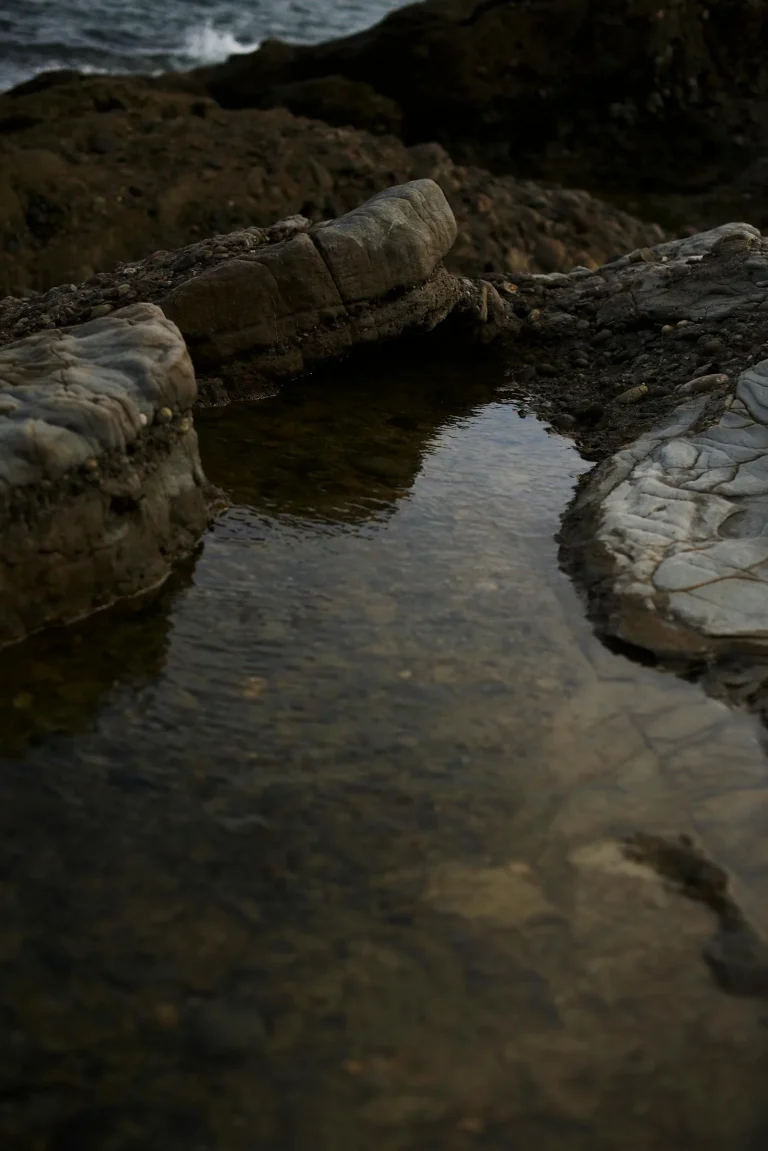
Rock pools are some of the most accessible wildlife habitats in Britain, appearing wherever hard rock meets the sea and the tide retreats. A single pool, no larger than a kitchen table, can contain dozens of species from four or five different animal groups — and finding them requires nothing more than a pair of wellies, low tide, and patience. This guide covers the main animals you will actually encounter in UK rock pools, how to identify them, and what to look for to find the species that are harder to spot.
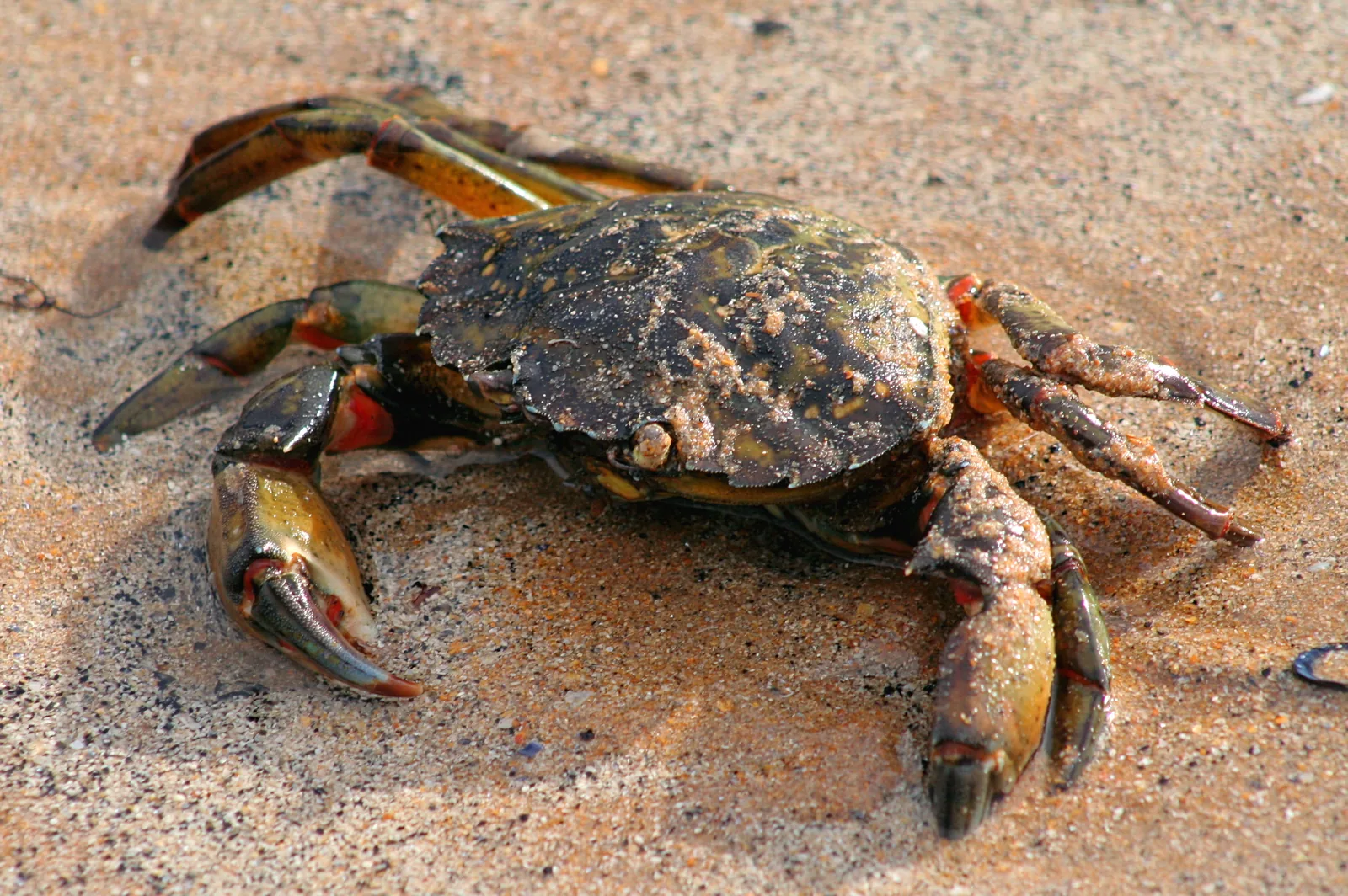
- The shore crab (Carcinus maenas) is the most abundant crab in Britain and found in rock pools on virtually every rocky coast
- Gobies and blennies are the most common rock pool fish — distinguished by their dorsal fins: two separate fins (goby) versus one continuous fin (blenny)
- Beadlet anemones appear as dark red or green blobs at low tide and expand into flower-like animals with up to 96 tentacles when covered by water
- The full list of British Isles rock pool species runs to well over 200 species of animals and plants; a single visit to a species-rich shore might yield 20–40 species
Crustaceans: Crabs, Prawns, and Barnacles
Shore crabs and swimming crabs
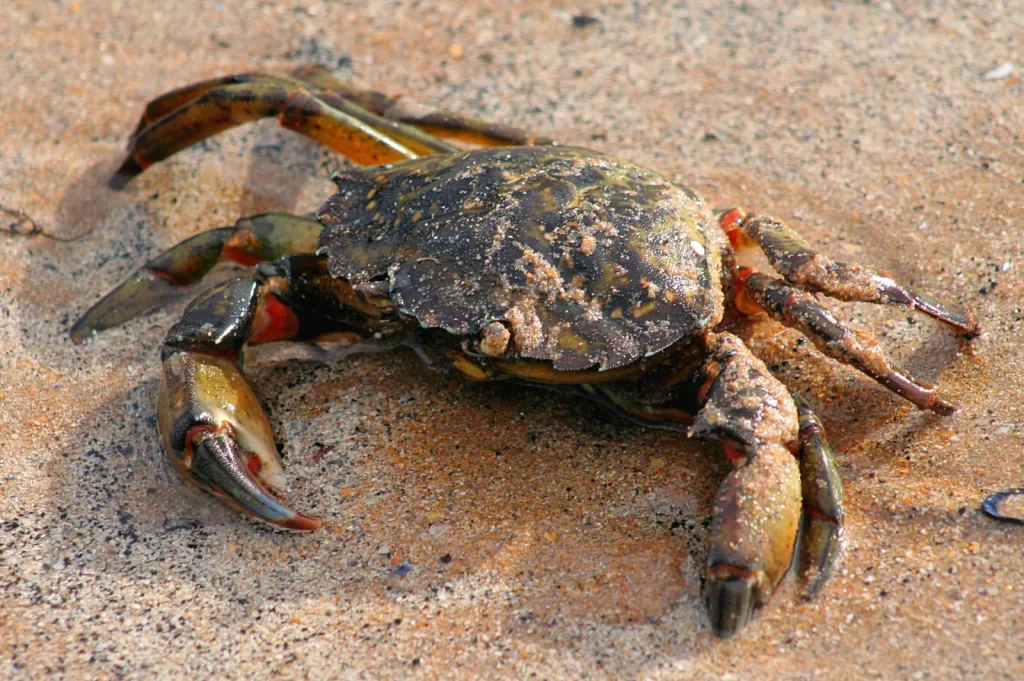
The most commonly encountered crab in UK rock pools is the shore crab (Carcinus maenas), Britain’s most abundant crab species, found on virtually every rocky, sandy, and estuarine shore around the country. Shore crabs have an olive-green to dark grey carapace (shell) with a distinctively jagged front edge showing five teeth between the eyes, and three rounded lobes on each side. They are unfussy and highly adaptable, hiding under boulders and in seaweed at low tide and emerging to scavenge when submerged. Juvenile shore crabs are often found in large numbers in upper-shore pools; adults favour mid- and lower-shore areas and can be found under virtually every substantial stone that gets turned over.
The velvet swimming crab (Necora puber) is a more striking and considerably more aggressive species, identifiable immediately by its bright red eyes and the velvety texture of its carapace. Unlike shore crabs, velvet swimmers are active predators with flattened hind legs that function as paddles for swimming. They live lower on the shore than shore crabs and can be found in deeper, rockier pools on exposed coasts. Their disposition when encountered is invariably hostile — they rear up and snap their claws — which makes them memorable. The edible crab (Cancer pagurus), larger and rounder with a characteristic crimped pie-crust edge to its shell, is found in lower-shore pools and under boulders on exposed coasts.
Hermit crabs and prawns
Hermit crabs are one of the most reliably found and endlessly fascinating rock pool animals. The common hermit crab (Pagurus bernhardus) lives inside the empty shell of a whelk, periwinkle, or other gastropod, dragging it across the pool floor and withdrawing inside when threatened, with its large right claw sealing the entrance. As the hermit crab grows, it must find a larger shell, and the process of shell-changing — which involves testing a candidate shell before making a rapid switch — can be observed with patience. They are conspicuous in mid- and lower-shore pools, often in significant numbers: fifty or more individuals can be found on a productive shore. Common prawns (Palaemon serratus) inhabit the same zones, nearly transparent and almost impossible to see until they move — a flicker of legs and antennae in the weedy margins of a deeper pool.
Barnacles, though sessile (permanently attached), are crustaceans rather than molluscs. The acorn barnacle (Semibalanus balanoides) covers exposed rock surfaces above and at the tideline in dense colonies, cemented in place and sealed by their plate-like covers when the tide is out. When submerged, they open and extend feathery legs (cirri) to filter plankton from the water. The familiar white crust of barnacles on any rocky shore is almost entirely acorn barnacles, and they form the base of the food web — grazed by limpets, drilled by dog whelks, and picked off by oystercatchers and turnstones.
Fish, Anemones, and Soft-Bodied Animals
Rock pool fish: blennies, gobies, and sea scorpions
The most common fish in UK rock pools are blennies and gobies, and the easiest way to distinguish them is by their dorsal (back) fins: gobies have two separate dorsal fins, while blennies have a single continuous fin running most of the length of their back. The shanny (Lipophrys pholis), also called the common blenny, is the most frequently encountered blenny — a mottled greenish-brown fish up to 15cm long, scaleless but protected by a thick coating of slime, often sitting still at the pool edge or in a crevice with its head and eyes visible. Blennies are able to breathe air briefly and can survive in very shallow water and even on moist rock surfaces for short periods. The common goby (Pomatoschistus microps) is a smaller, more uniformly sandy fish, often found in sandy-bottomed pools, up to 6cm long and easily overlooked.
The long-spined sea scorpion (Taurulus bubalis) is more dramatically camouflaged than either — a broad-headed, spiny fish with a large pectoral fin and coloration that matches the algae-covered rock exactly. It sits motionless at the bottom of pools, relying entirely on camouflage and requiring close examination to spot. Found in mid- and lower-shore pools, it can appear to materialise in a pool you have been staring at for several seconds. The shore rockling (Gaidropsarus mediterraneus) is eel-like in shape, up to 25cm long, and hides under rocks and in crevices. The butterfish (Pholis gunnellus), flattened and slippery with a row of dark eye-spots along its dorsal fin, is another species found under stones at low tide.
Anemones, sea slugs, and hydroids
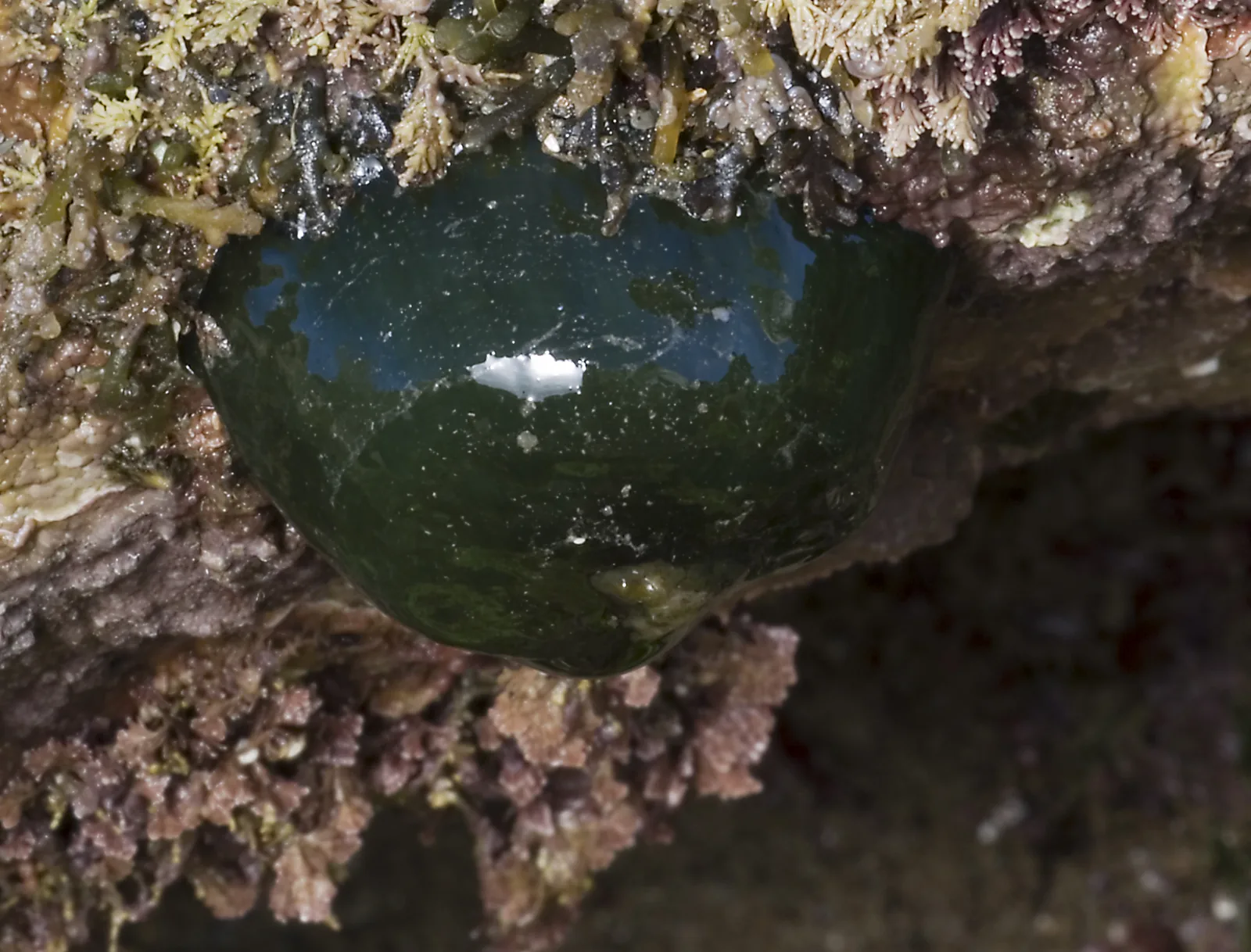
The beadlet anemone (Actinia equina) is the most common anemone in British rock pools, typically dark red but occasionally brown, orange, or green. At low tide it retracts entirely into a blob of jelly, indistinguishable from a limpet scar or a dark patch of encrusting alga. When submerged, it expands to reveal up to 96 tentacles arranged in rows around its disc, each loaded with stinging cells used to paralyse small crustaceans and fish. A ring of bright blue bead-like structures (acrorhagi) is sometimes visible at the base of the tentacle column — these are defensive weapons used in territorial battles with neighbouring anemones. The snakelocks anemone (Anemonia viridis) is different in that it cannot retract its long, swaying tentacles, which are typically grey-green with purple tips and may be symbiotic with photosynthetic algae (zooxanthellae) that give the tentacles their colour.
Sea slugs (nudibranchs) are specialist finds, typically small and found only in lower-shore pools and under stones. The grey sea slug (Aeolidia papillosa) preys specifically on beadlet anemones and stores the anemones’ undischarged stinging cells in its own cerata (finger-like projections) for defence — one of the most striking examples of a predator weaponising its prey’s defences. Oaten pipe hydroids (Tubularia indivisa) look more like plants than animals but are colonial cnidarians (relatives of jellyfish and anemones), found as pink-stemmed colonies with flower-like heads in sheltered lower-shore pools and under overhangs.
Molluscs, Echinoderms, and Seaweed
Limpets, periwinkles, mussels, and whelks
The molluscs are the most visible animals on the rocky shore at low tide. Common limpets (Patella vulgata) are the most immediately recognisable — conical ridged shells up to 6cm across, clamped firmly to bare rock everywhere from the splash zone to the lower shore. Limpets graze a circuit of algae from a fixed home scar, returning to exactly the same spot after each tidal excursion; the scar fits the individual limpet’s shell so precisely that no other limpet can displace it. Common periwinkles (Littorina littorea) are abundant in the mid-shore and graze on algae; smaller flat periwinkles (Littorina obtusata) are found on bladderwrack fronds. Dog whelks (Nucella lapillus) are predatory gastropods that drill through the shells of barnacles and mussels using a specially modified organ — their neat circular holes are a common find on empty mussel shells.
Common mussels (Mytilus edulis) form dense colonies on mid-shore rock faces, the individuals attached to each other and the rock by byssus threads. They are filter feeders, drawing water through their gills to collect phytoplankton. Chitons — flattened molluscs with eight articulated shell plates, sometimes called coat-of-mail shells — are found pressed flat to rock surfaces and require deliberate searching. The octopus (Octopus vulgaris) and curled octopus (Eledone cirrhosa) are occasional lower-shore finds in southern England, hiding under boulders with a telltale pile of crab and shell debris outside their den.
Echinoderms: starfish, urchins, and brittle stars
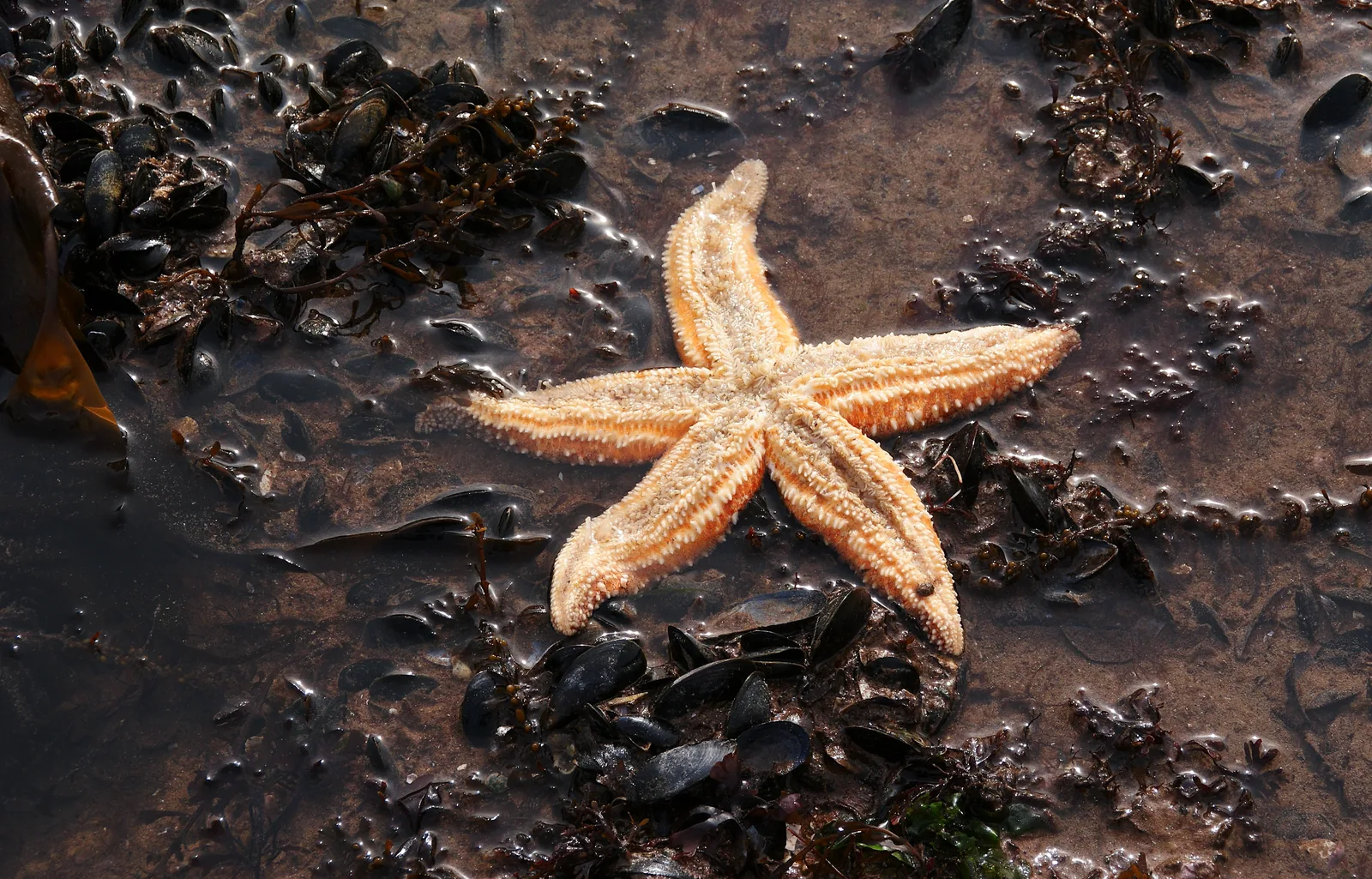
The common starfish (Asterias rubens) is found in lower-shore pools and under boulders — usually orange but occasionally brown or purple, typically 10–20cm across, with five arms (some individuals have six). It preys on mussels and barnacles, using its tube feet to pull bivalve shells apart and extruding its stomach into the gap to digest the contents outside its body. The cushion star (Asterina gibbosa) is a much smaller species — rarely more than 5cm — with short, stubby arms giving it a pentagonal shape; it is common under stones on south and west coasts. Brittle stars have five slender arms radiating from a central disc and move by rowing the arms; they are fast, shy, and usually found under stones or in crevices.
The edible sea urchin (Echinus esculentus) is found in lower-shore pools on exposed coasts, particularly in the west and north. Its test (shell) is up to 15cm across, covered in spines, and the animal grazes algae, encrusting animals, and detritus. Empty urchin tests — bleached white with a rose-coloured tinge and the spine attachment points showing as small bumps — are a common beach find. The sea potato (Echinocardium cordatum), a burrowing heart urchin, is found in sand rather than rock pools; its heart-shaped test is a frequent beach find.
For specific rock pooling destinations, our guides to West Runton rock pools (Norfolk’s chalk reef) and Filey Brigg rock pools (Yorkshire’s Jurassic coast) cover what you will find in those specific locations. For other water-based outdoor activities, see our guide to outdoor swimming pools and lidos in the UK.
Frequently Asked Questions
What animals are most commonly found in rock pools in the UK?
The most commonly found animals in UK rock pools are shore crabs (Carcinus maenas), common hermit crabs (Pagurus bernhardus), common prawns, beadlet anemones, limpets, periwinkles, mussels, dog whelks, barnacles, common gobies, and shannies (common blennies). These species are found on rocky shores throughout the UK at low tide and are visible without specialist equipment.
What fish live in rock pools?
The most common rock pool fish in the UK are blennies (especially the shanny, Lipophrys pholis) and gobies (especially the common goby, Pomatoschistus microps). The long-spined sea scorpion (Taurulus bubalis) is also frequently found, sitting motionless and camouflaged. Shore rockling, butterfish, and worm pipefish are also recorded in mid- to lower-shore pools. Gobies have two separate dorsal fins; blennies have a single continuous dorsal fin running most of the body length.
How do you spot animals in rock pools?
Most rock pool animals are camouflaged and inactive at low tide. The best approach is to crouch quietly at the pool edge and observe without moving for 30–60 seconds, allowing any disturbed animals to settle. Look under rocks carefully (and replace them immediately); examine the margins of pools under overhangs; check seaweed fronds for anemones and molluscs; look at the pool bottom for stationary fish like sea scorpions and flat gobies. Moving water in a pool that has no current usually means a hidden prawn or crab.
Are there dangerous animals in rock pools?
No UK rock pool species presents a serious danger to humans. The main hazards are minor: velvet swimming crabs will snap with their claws if handled. The lesser weever fish (Echiichthys vipera), which buries itself in sand rather than rock pools, has venomous spines that cause painful stings if trodden on in sandy areas near rock pools. Snakelocks anemone tentacles can cause a mild skin reaction in sensitive individuals. The main risks at rock pools are from the environment — slippery surfaces and returning tides — rather than the animals.
Can you keep animals from rock pools?
In the UK, removing living animals from rock pools is strongly discouraged by conservation guidelines and illegal at designated Marine Protected Areas and SSSIs. Animals should be observed in the pool, briefly lifted for identification if needed, and returned immediately to the exact pool and position where they were found. Many coastal SSSI sites impose legal restrictions on collecting. Animals removed from rock pools and taken home almost always die quickly, as maintaining correct water conditions without specialist equipment is not feasible.