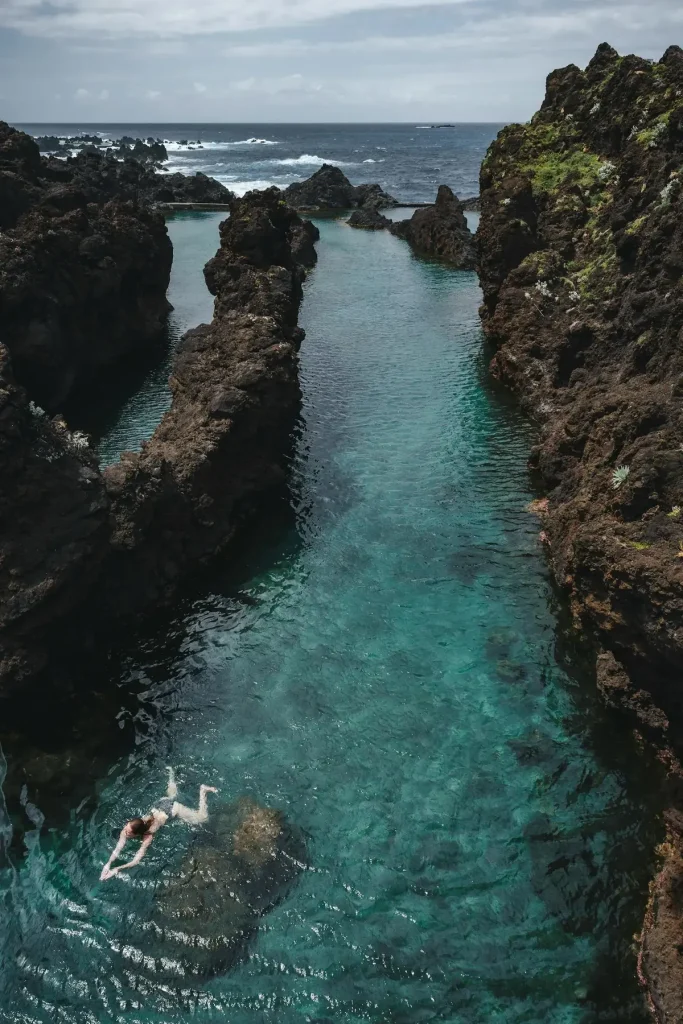
Madeira’s volcanic rock pools are natural saltwater basins carved into the island’s basalt coastline by millions of years of Atlantic wave action on cooling lava. They are not artificial swimming pools — each pool is a hollow or channel in the black volcanic rock, permanently filled and refreshed by the sea. The most famous are at Porto Moniz on the northwest coast, but significant pools also exist at Seixal (north coast) and Doca do Cavacas near Funchal. Unlike the constructed natural swimming pools built in UK gardens, Madeira’s volcanic pools are entirely geological in origin — shaped by the same eruptions that built the island itself. This guide covers how the pools formed, the main locations, entry fees, water temperatures and the best time to visit.
- Porto Moniz (northwest coast): the most visited volcanic pool complex. Paid zone costs €3/adult; free natural pools adjoin it. Open 09:00–19:00 in summer.
- Seixal (north coast): the most dramatic free pools, featuring a natural volcanic rock arch overhead. Steep access — 33% gradient road plus stairs.
- Doca do Cavacas (Funchal south coast): the only natural pools on the south side of the island, 10 minutes from central Funchal, with views across to Cabo Girão.
- Water temperature: 20–22°C in summer (June–October), dropping to 16–18°C in winter. Pools are swimmable year-round but can close during winter storms.
Madeira’s Volcanic Pools: Formation and the Main Locations
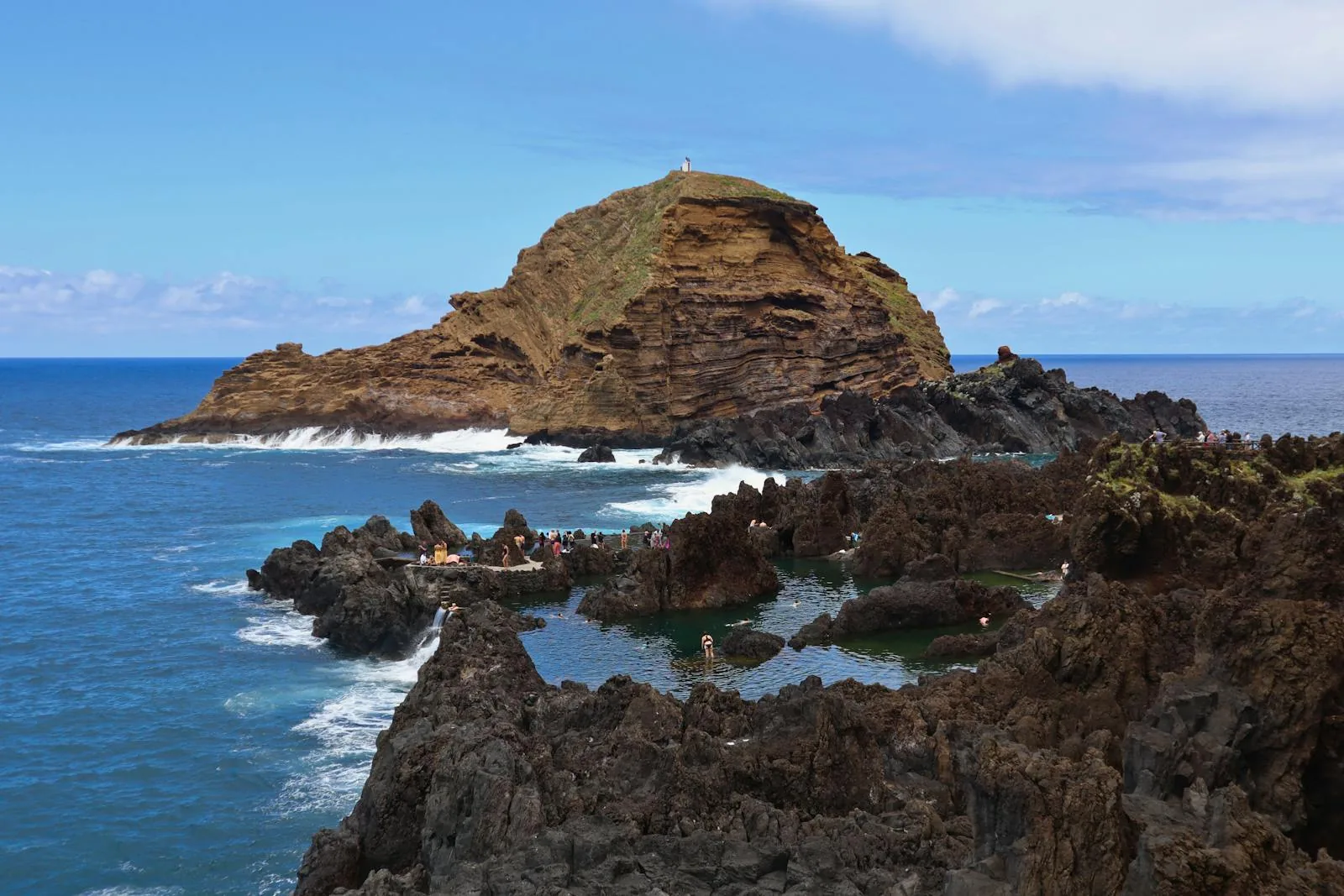
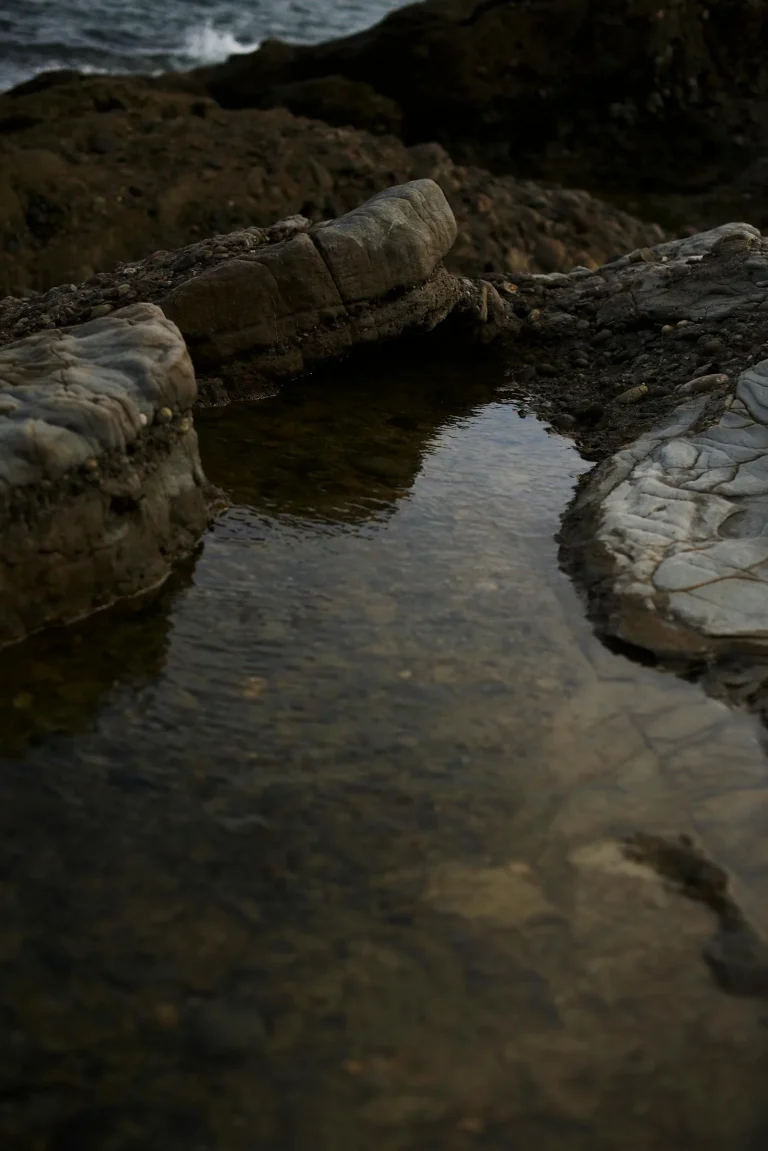
Madeira is a mid-Atlantic volcanic island whose oldest rocks formed around five million years ago. Periodic eruptions continued until approximately 25,000 years ago, and each lava flow that reached the coast cooled into black basalt. Over millennia, Atlantic waves eroded the softer rock, leaving behind hollows, channels and natural basins in the harder basalt — what locals call piscinas naturais (natural pools). The pools are not sealed: seawater flows in and out continuously through cracks and over the rock walls with each tide and swell, keeping the water clear and oxygenated without any filtration system. The porous volcanic lava acts as a natural filter as water passes through it.
Porto Moniz: Madeira’s Most Visited Rock Pools
Porto Moniz sits at the northwestern tip of the island, roughly an hour’s drive from Funchal. Its volcanic pools are the island’s most visited natural attraction, drawing visitors who come for the combination of dramatic black basalt scenery and accessible, calm swimming. There are two distinct zones:
- Free pools (Ilheu Mole area): entirely natural, unmanaged basalt pools directly adjoining the sea. These are wilder and more visually striking but also more exposed — the black basalt is sharp, slippery and unforgiving if you fall.
- Paid bathing complex: the managed pool zone, with concrete-edged pools, changing rooms, lockers, lifeguards on duty, sunbed hire, a snack bar, a playground and first-aid facilities. Entry costs €3 for adults, with reduced rates for children and local residents (under-3s swim free). The complex opens 09:00–19:00 in summer and 09:00–17:00 in winter. Arrival by 10:30 is recommended in July and August, as sunbeds sell out quickly when tour coaches arrive around midday.
Seixal: The Best Free Volcanic Pools
The Seixal pools on the north coast are widely considered the most dramatic free option. The complex comprises two saltwater pools — Poça das Lesmas and Poça do Mata Sete — carved into black lava rock at the foot of a steep sea cliff. A large natural volcanic arch spans the main pool, channelling the Atlantic swell into a contained swimming area. Access requires descending a road with a 33% gradient followed by steep stairs, so mobility considerations apply. The pools are open and free at all times; there are no facilities on site.
Doca do Cavacas: Funchal’s Volcanic Pool
For visitors based in Funchal, Doca do Cavacas is the accessible option — a 10-minute drive from the Funchal promenade in the suburb of Lido. As the only natural swimming area on the island’s south coast, it offers calmer conditions than the north-coast pools, with views across to the fishing village of Câmara de Lobos and towards Cabo Girão, at 580 metres one of the highest sea cliffs in Europe. The pools here have a small admission charge and basic facilities.
Visiting Madeira’s Volcanic Pools: Entry, Safety and the Best Season
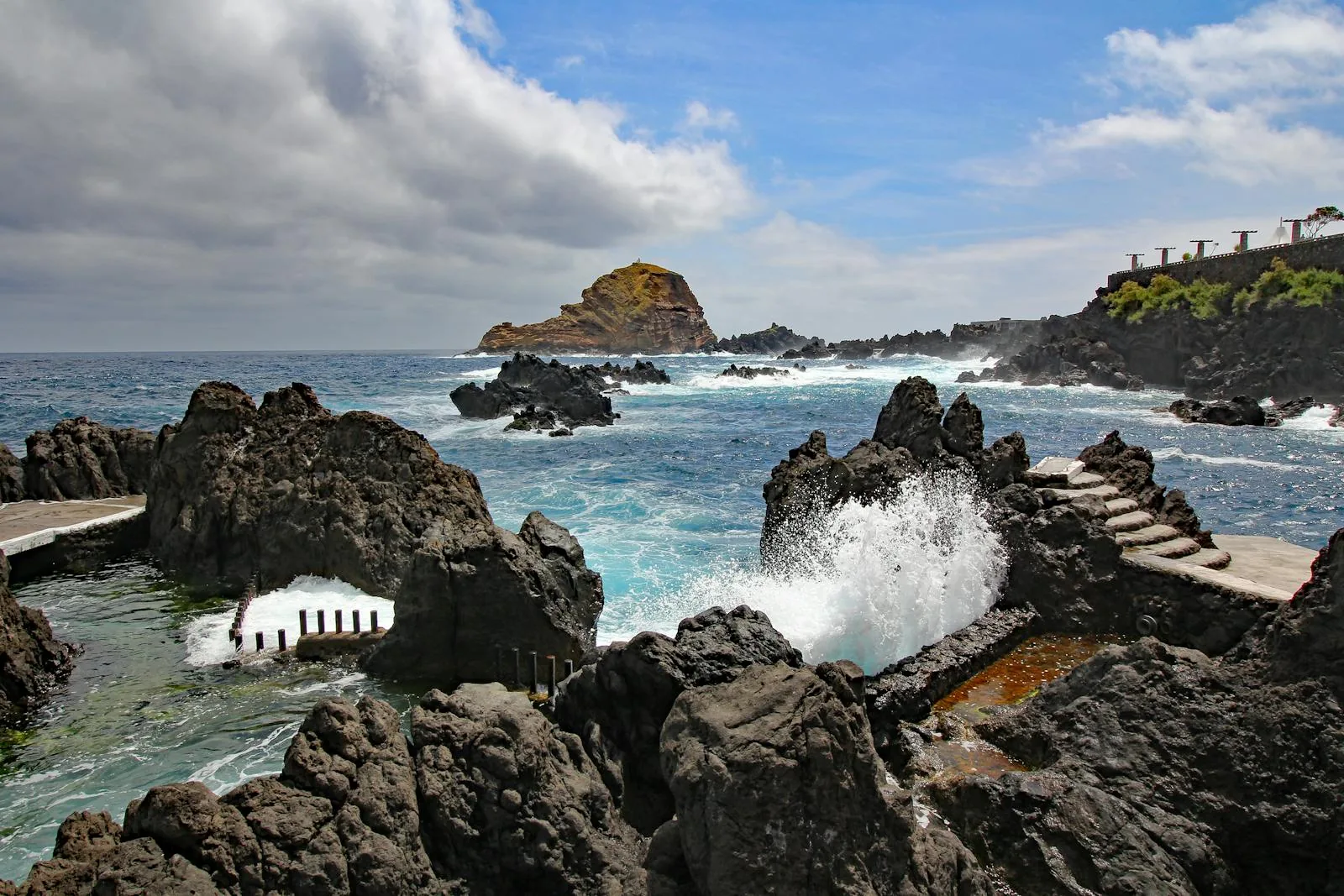
Madeira’s pools are accessible year-round but behave very differently across seasons. The north coast pools in particular are directly exposed to the prevailing Atlantic swell, which can make them dangerous or completely inaccessible outside the summer swimming season.
Entry Fees and Facilities by Location
| Pool | Entry Fee | Facilities | Notes |
|---|---|---|---|
| Porto Moniz (paid zone) | €3/adult | Lifeguards, changing rooms, snack bar, sunbeds | Busiest 12:00–15:00 in peak season |
| Porto Moniz (free zone) | Free | None | No lifeguard; unmanaged basalt |
| Seixal | Free | None | Steep access; rock arch feature |
| Doca do Cavacas | Small charge | Basic facilities, café | South coast; calmer conditions |
Best Time to Visit and Water Temperatures
The swimming season runs from late June through October, when water temperatures reach 20–22°C (68–72°F) and the Atlantic swell is at its lowest. In July and August water temperatures peak in the mid-20s°C — comfortable for extended swimming. The winter months (November to May) bring what locals call the “Monster Waves” season, when Atlantic storms drive large swells into the north coast; the Porto Moniz paid complex often closes its pools during this period, and the Seixal pools can be completely submerged and dangerous. Doca do Cavacas on the south coast remains accessible more consistently through the year due to its sheltered aspect. For visitors interested in other natural pool destinations, Pamukkale’s thermal travertine pools in Turkey offer a contrasting experience — geothermal rather than tidal, with a constant 36°C year-round.
Safety on Volcanic Rock
The primary hazard at all Madeira volcanic pools is the black basalt itself. Unlike sand beaches, volcanic rock is extremely sharp and slippery when wet — cuts from falls are common. Madeira’s tourism authority recommends water shoes at all volcanic pool sites. A secondary hazard is unexpected wave surges at unmanaged sites: even on calm days, sets of larger waves periodically wash over pool edges, particularly at Seixal and the free Porto Moniz zone. Checking the local swell forecast before visiting unmanaged pools is advisable. At the Porto Moniz paid complex, lifeguards close the pools when conditions become unsafe. If you are planning a longer stay and considering private villas in Portugal with pools, Madeira has numerous self-catering properties within easy reach of the volcanic pool sites.
Frequently Asked Questions
What are Madeira’s volcanic pools?
Madeira’s volcanic pools are natural saltwater swimming areas formed in hollows and channels in the island’s black basalt coastline. They were created over millions of years as Atlantic waves eroded the lava rock left by the island’s volcanic eruptions. The pools are continuously filled and refreshed by the sea via tidal flow, which keeps the water clear without artificial filtration. The most famous are at Porto Moniz on the northwest coast, with additional pools at Seixal and Doca do Cavacas near Funchal.
How much does it cost to enter the Porto Moniz natural pools?
The managed Porto Moniz bathing complex charges €3 for adults. Children under 3 enter free; pensioners and people with disabilities pay a reduced rate; local Madeiran residents pay €0.50. Adjacent free natural pools at the Ilheu Mole area have no charge, but they have no facilities and no lifeguard cover.
Can you swim in Madeira’s volcanic pools in winter?
Swimming is technically possible in winter at some pools, particularly the south-coast Doca do Cavacas, but the north-coast pools at Porto Moniz and Seixal are frequently dangerous or closed from November to May due to large Atlantic swells — the local “Monster Waves” season. Water temperatures drop to 16–18°C in winter. The best swimming season is June to October, when water temperatures reach 20–22°C and conditions on the north coast are calmer.
Are the Seixal pools better than Porto Moniz?
The Seixal pools are free, larger and widely regarded as more dramatic, with a natural volcanic rock arch spanning the main pool. However, they have no facilities (no lifeguard, no changing rooms) and access requires descending a 33% gradient road and steep stairs. Porto Moniz’s paid complex offers lifeguard cover, changing rooms, lockers, a snack bar and sunbeds for €3. The best choice depends on whether you prioritise scenery and cost (Seixal) or facilities and safety (Porto Moniz paid zone).
Do you need water shoes at Madeira’s volcanic pools?
Yes — water shoes are strongly recommended at all Madeira volcanic pool sites. The black basalt rock is extremely sharp and becomes very slippery when wet. Falls on volcanic rock commonly cause cuts that can be serious. At the Porto Moniz paid complex, the pool edges are concrete-finished, reducing the risk, but access paths and the free natural pools remain raw basalt throughout.