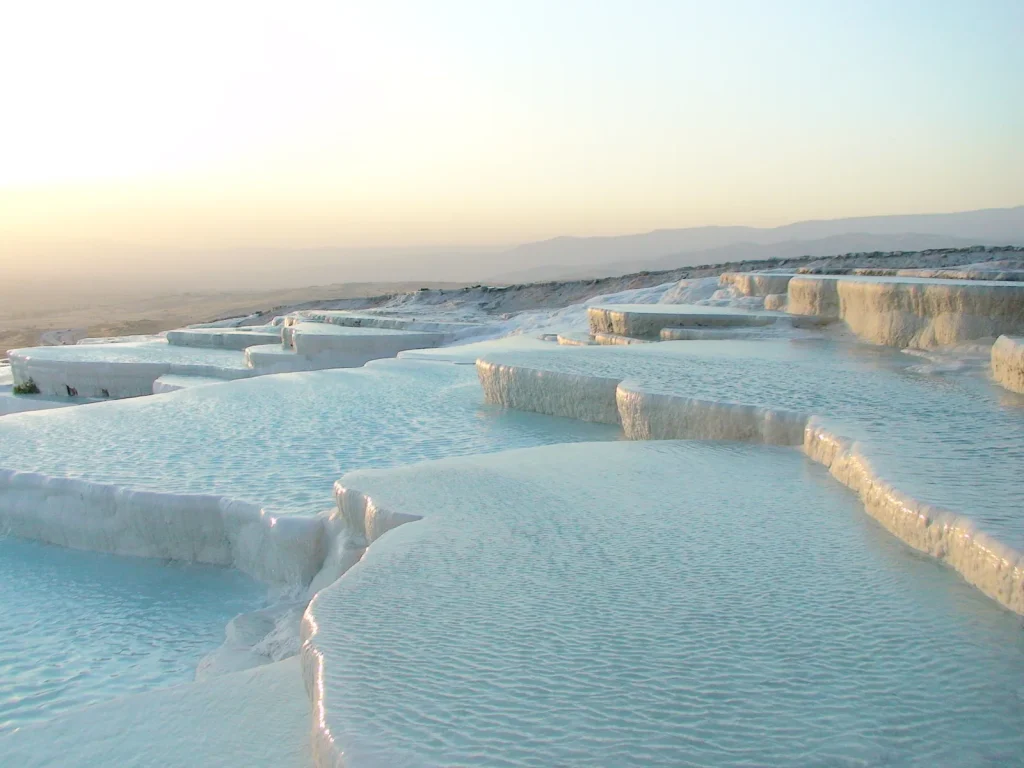
Picture a hillside in south-western Turkey draped in brilliant-white terraces filled with turquoise-blue water — that is Pamukkale, which translates from Turkish as “cotton castle.” This UNESCO World Heritage Site sits in Denizli Province and is fed by 17 natural hot springs whose mineral-rich water has been sculpting the landscape for at least 600,000 years. It draws more than 2 million visitors every year, making it one of Turkey’s most visited natural attractions. Some terraces are open for barefoot wading; the famous Cleopatra’s Antique Pool lets you swim at a constant 36°C among submerged Roman columns. This guide explains how the pools form, exactly what you can swim in, what everything costs in 2026, and the fastest routes to get there.
- Pamukkale’s white terraces are made of travertine deposited by calcium-rich thermal water from 17 springs (35°C–100°C).
- Visitors wade barefoot in shallow designated terraces; Cleopatra’s Antique Pool offers full swimming at 36°C for an extra €6.
- General site entry is €30 (includes Hierapolis ruins and museum); South Gate opens at 6:30 AM.
- Spring (March–May) and autumn (September–November) are the best times to visit; avoid mid-morning when tour buses arrive.
- Pamukkale is 20 km from Denizli — reachable by a 1-hour flight from Istanbul plus shuttle, or a 3–4 hour bus from Antalya.
How Pamukkale’s Thermal Pools Form: The Geology Behind the White Terraces
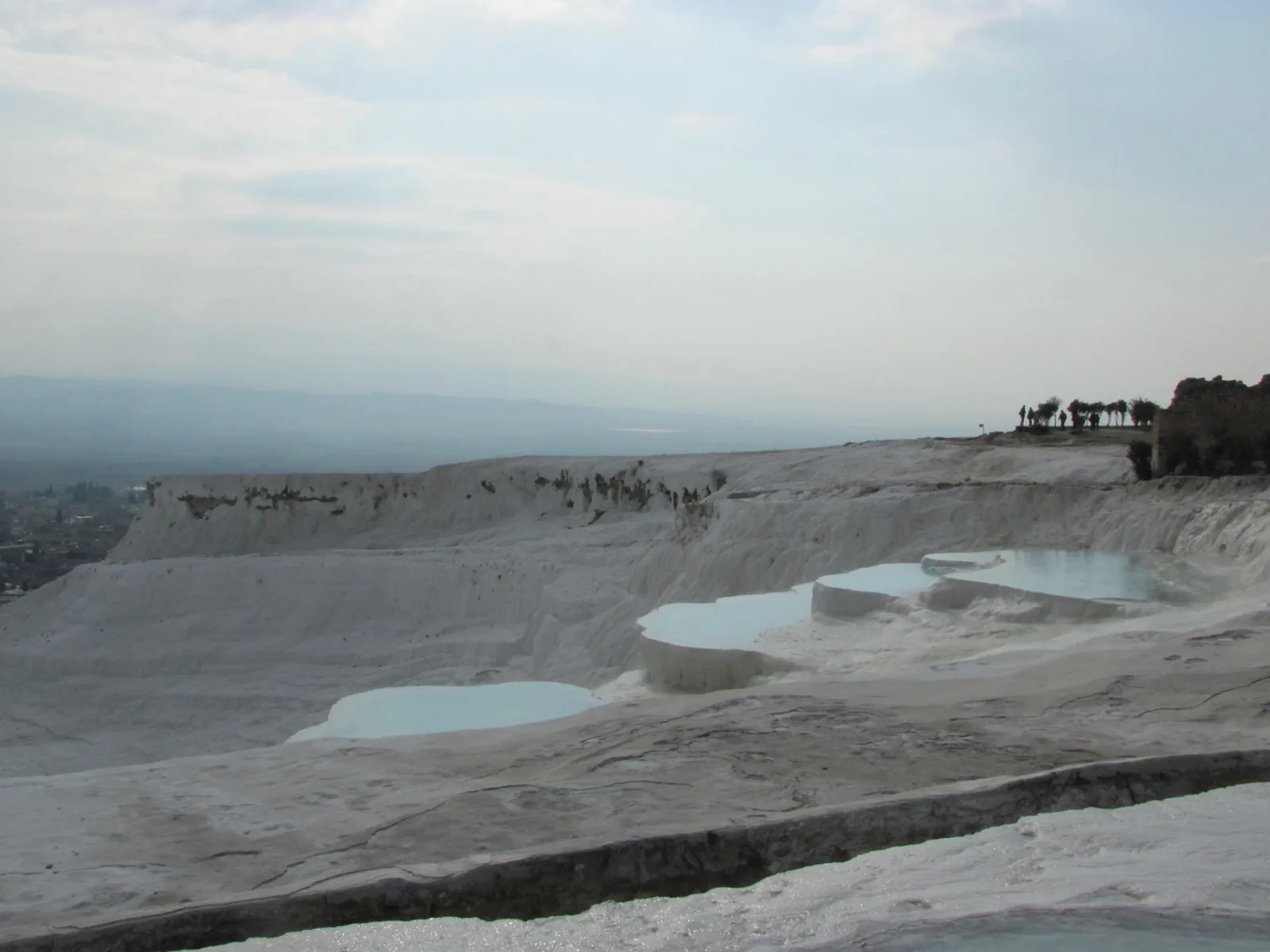
The visual drama of Pamukkale has a precise chemical explanation. Rainwater seeps deep into the faults and fissures of the Anatolian plateau, where geothermal heat from underlying magma warms it and causes it to leach calcium carbonate, magnesium and bicarbonate from the limestone bedrock. That mineral-saturated water then rises back to the surface through a network of springs. The moment it is exposed to air, carbon dioxide escapes from the solution — and as the CO₂ de-gasses, the water can no longer hold its dissolved calcium carbonate in solution, so it drops out as a soft gel that slowly crystallises into travertine. Repeat this across thousands of springs over hundreds of thousands of years and you get a 2,700-metre-long, 600-metre-wide hillside plated in white stone terraces up to 160 metres tall.
The 17 hot springs and the mineral chemistry that builds the terraces
According to Wikipedia’s detailed geological record, Pamukkale’s 17 hot springs emerge at temperatures ranging from 35°C to 100°C. At the point of emergence, the water carries a carbon dioxide concentration of 725 mg/l and a calcium carbonate concentration of 1,200 mg/l. By the time that same water has flowed 320 metres across the travertine terraces, its CO₂ has fallen to 145 mg/l and its calcium carbonate to just 400 mg/l — the difference (roughly 800 mg/l of calcium carbonate per litre of flow) has been deposited as new travertine along the way. The IUGS Geoheritage listing describes the site as one of the most significant active travertine systems on Earth for this reason.
Why some pools are brilliant white while others have turned grey
Not every terrace glows the same brilliant white you see in photographs. When Turkish authorities began developing tourism infrastructure in the 1960s and 1970s, hotels were built directly on the travertine. Their owners diverted spring water to fill hotel swimming pools, and guest footfall, sewage and littering caused mechanical damage to the stone. The result was visibly grey, degraded terraces. UNESCO’s 2002 state-of-conservation report confirmed that the diversion of thermal water had measurably reduced the flow feeding the formations. After the site received its UNESCO World Heritage inscription in 1988 (under criteria iii, iv and vii, reference number 485), management was transformed: the last two on-site hotels were demolished in 2001, considered one of the biggest conservation successes in the site’s history. Today, authorities regulate water flow and periodically close sections so they can bleach back to white under direct sun — which is why some Instagram-famous pools you may have seen are currently roped off.
How long the formation has been building and what keeps reshaping it
Travertine deposition at Pamukkale has been ongoing since at least the Pleistocene epoch — roughly 600,000 years ago — though much of the active build-up visible today occurred in the last 50,000 years, according to geological science records. The landscape is still changing: the 320-metre water channel that feeds the terrace head shifts the deposition zone every season, and pools fill, overflow and drain in ways that alter the hillside’s profile year on year. The full heritage site covers 1,077 hectares and is managed alongside the ancient city of Hierapolis, which the Romans founded as a thermal spa town in the early 2nd century BC precisely because of the springs. The combined Hierapolis-Pamukkale site carries enough geological significance that NASA’s Earth Observatory has photographed it from orbit as a case study in visible mineral deposition.
What You Can Swim In at Pamukkale: Travertine Terraces and Cleopatra’s Pool Compared
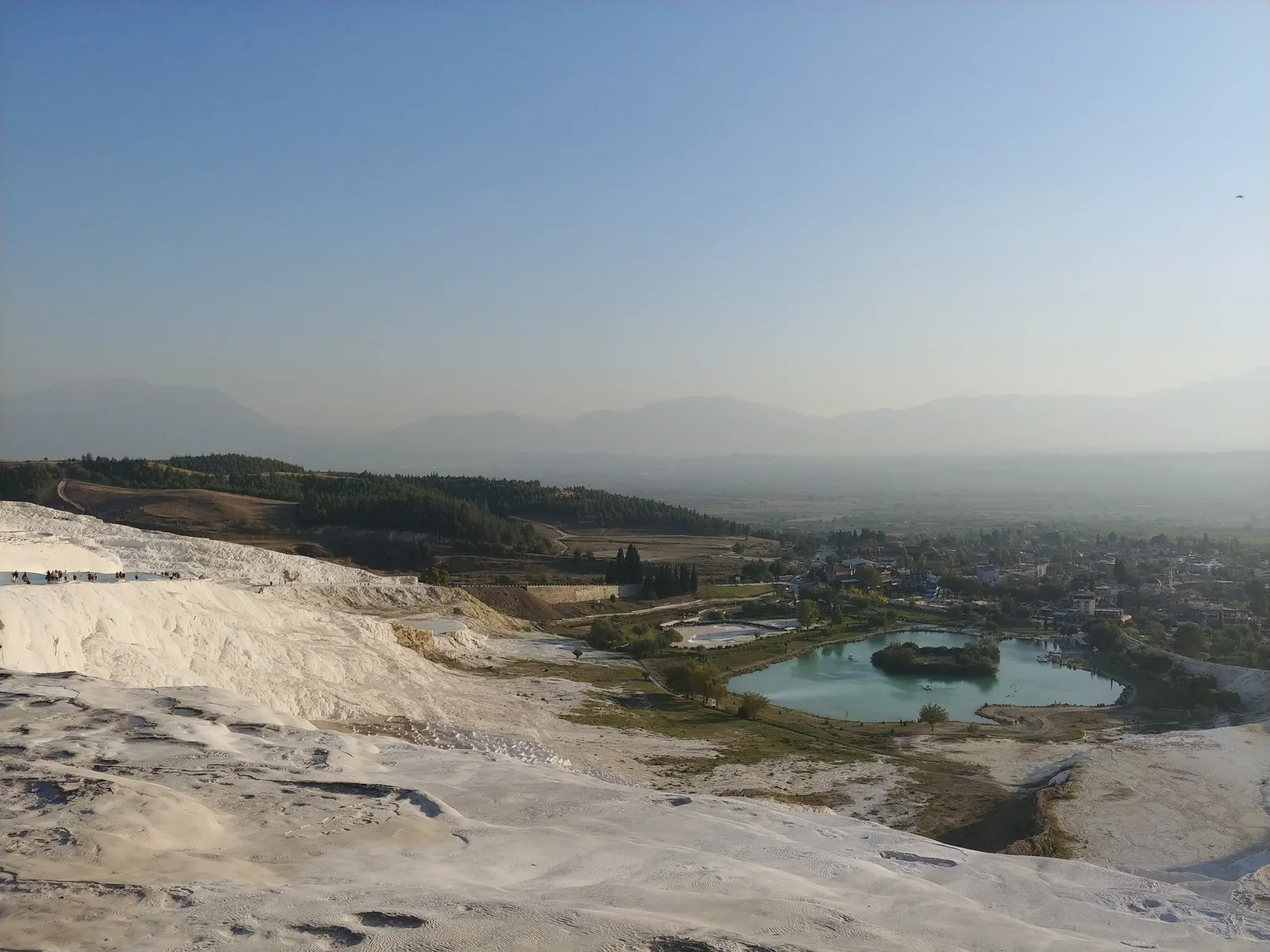
A common disappointment among first-time visitors is arriving expecting to plunge into the white terraces and finding they can only wade in shallow designated pools. The site has two distinct swimming experiences and understanding the difference before you visit saves frustration. The open travertine terraces are about barefoot wading — ankle-to-knee-deep water, no chlorination, and only certain pools open at any given time. Cleopatra’s Antique Pool is a separate, fully swimmable thermal pool with ancient Roman ruins submerged in its floor. The table below compares the two at a glance.
| Feature | Travertine Terraces | Cleopatra’s Antique Pool |
|---|---|---|
| Entry cost | Included in €30 site fee | €30 site fee + €6 pool fee |
| Water temperature | ~30–35°C (varies by terrace) | Constant 36°C |
| Swim type | Barefoot wading only | Full swimming |
| Depth | Ankle to knee (designated pools) | Up to 1.5–2 m |
| Submerged ruins | No | Yes — marble columns, stone capitals |
| Chlorination | None | None (natural mineral water) |
| Open hours | Site hours (see below) | 8:00 AM – 8:00 PM daily |
Wading the travertine terraces: what the barefoot walk is actually like
When you reach the terraces, you remove your shoes at a designated rack near the entrance and walk in bare feet onto warm white limestone. The designated wading sections are shallow — typically ankle to knee deep — and the water temperature varies between roughly 30°C and 35°C depending on which terrace you are on and the season. The surface feels smooth but is genuinely slippery at the upper, busier sections where thousands of feet have polished the stone. Most visitor guides recommend heading to the lower and middle terraces, where the water is clearer and foot traffic is lighter. The pools are not cleaned or chlorinated, so lower pools tend to have less suspended sediment. You are not permitted to use soaps, lotions or sunscreen in the water, as these chemicals damage the delicate mineral surface. Stick to the marked paths — veering off risks stepping on fragile sections under restoration.
Cleopatra’s Antique Pool: swimming among submerged Roman columns
The Cleopatra’s Antique Pool (officially the Antique Pool or Hierapolis Thermal Pool) is the headline swimming experience at the site. The pool maintains a constant 36°C year-round, fed directly from one of Pamukkale’s natural springs, and its mineral-rich water is effervescent — you can feel tiny bubbles against your skin from the dissolved carbon dioxide. What makes it unique is the floor: scattered marble columns, stone capitals and architectural fragments lie submerged in the water, believed to have been toppled by the major earthquake of AD 17 that destroyed much of the Roman city of Hierapolis above. Swimming over these ruins — they are clearly visible through the mineral water — is unlike any other thermal experience in Europe or the Middle East. The pool’s therapeutic mineral composition includes calcium carbonate, sulfate, magnesium and bicarbonate, and published hydrotherapy research supports benefits for circulation, joint pain and skin conditions with regular immersion. For entirely natural swim experiences closer to home, natural swimming pools in the UK offer a comparable low-chemical alternative.
Entry prices, opening hours and what the ticket covers in 2026
The single site ticket covers access to the travertine terraces, the Hierapolis archaeological site (founded approximately 190 BC) and the Hierapolis Museum. Cleopatra’s Antique Pool requires an additional fee paid at the poolside desk. All prices are set by Turkish authorities and were confirmed at the following rates for 2026:
| Ticket | Price (2026) | Includes |
|---|---|---|
| General site admission (adults) | €30 (~700 TL) | Terraces, Hierapolis ruins, Museum |
| Cleopatra’s Antique Pool (adults) | €6 extra | Pool access only |
| Children 6–12 | Reduced rate | Same as adult ticket type |
| Children under 6 | Free | — |
Opening hours: South Gate opens at 6:30 AM (the only entrance available at that time). North Gate and Town Entrance open at 8:00 AM. Summer closing (April–September): 9:00 PM; winter closing (October–March): 7:00 PM. The site is open every day of the year and is located 20 km from Denizli city centre.
Getting to Pamukkale and When to Visit: A Practical Guide for Travellers
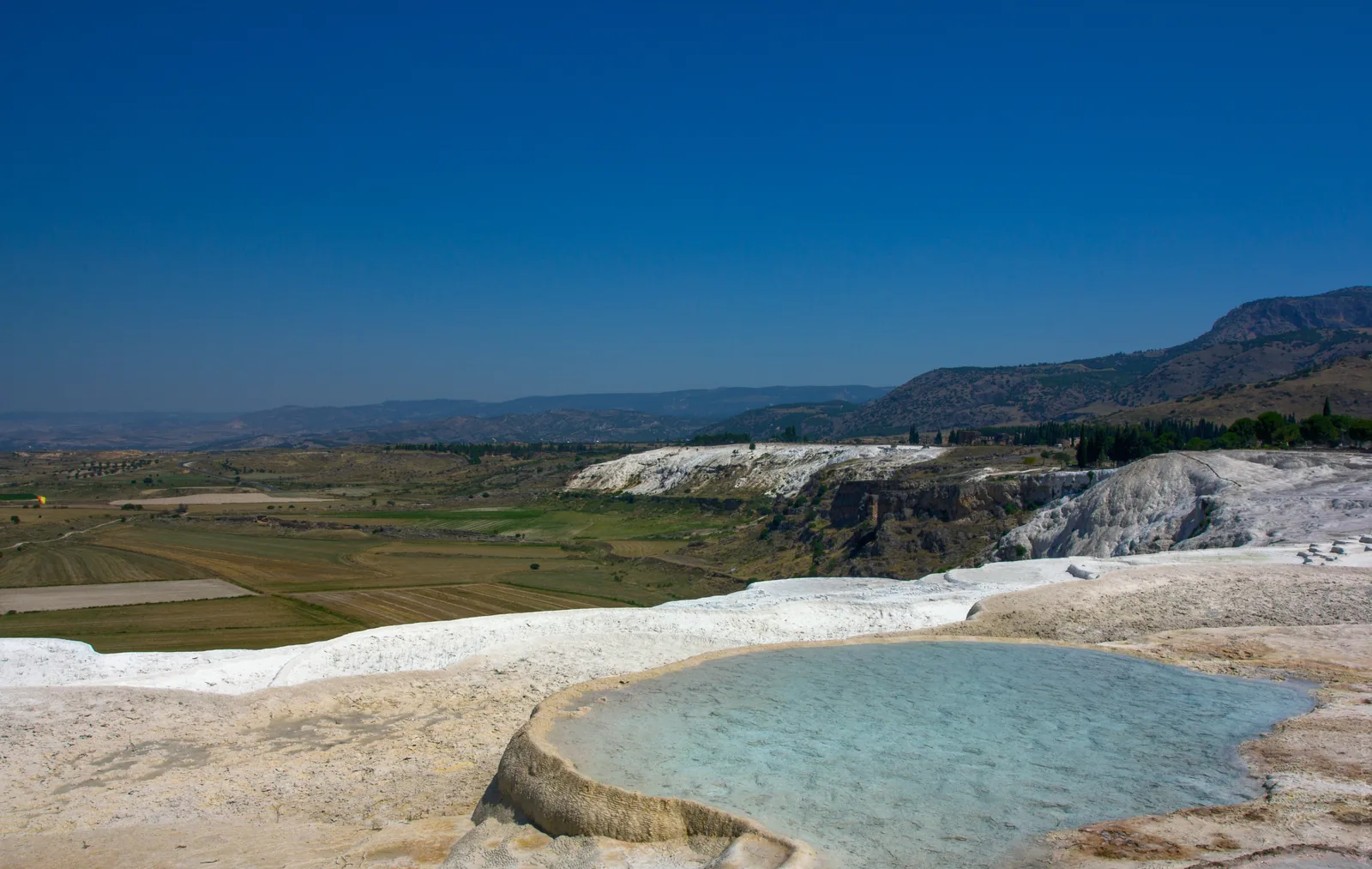
Pamukkale sits in Denizli Province, south-western Turkey, roughly equidistant from several major tourist hubs. The nearest airport is Denizli Çardak Airport (DNZ), about 60 minutes by shuttle from the site. Most travellers from the UK fly into Istanbul or Antalya and connect onward, so transport options differ considerably depending on your base.
How to reach Pamukkale from Istanbul, Izmir and Antalya
From Istanbul (570 km): the fastest route is a direct flight of approximately 1 hour 10 minutes from Istanbul Airport or Sabiha Gökçen Airport to Denizli Çardak, followed by a 60-minute shuttle to the site. Alternatively, overnight coach services from Istanbul’s Esenler bus terminal take 10–12 hours; operators Kamil Koç and Pamukkale Turizm both run regular departures and are the most budget-friendly option.
From Izmir: the bus route to Denizli takes 3–4 hours and costs approximately $5 one way — the most straightforward budget option. Minibuses from Denizli bus station cover the final 20 km to Pamukkale directly.
From Antalya (240 km): coach services take 3–4 hours and run frequently. Denizli Railway Station also connects via rail; minibuses and taxis outside the station go directly to Pamukkale. If you are combining Pamukkale with a coastal Turkey holiday, hotels with private pools or swim-up rooms along the Aegean or Mediterranean coast make practical bases for a day trip to the site.
Best times to visit and how to avoid the crowds
Pamukkale attracts over 2 million visitors annually, with peaks in July and August. The best windows for a quieter visit are spring (March–May) and autumn (September–November), when temperatures are mild and visitor numbers lower. In 2014 — one of the busiest recorded years — the site registered 1,874,657 visitors to Hierapolis, per UNESCO monitoring data; 2016 saw a significant dip to 974,508, demonstrating how sharply visitor volumes can shift.
Regardless of season, the most effective tactic for avoiding crowds is timing your arrival. Tour buses from Denizli and Antalya begin arriving at 7:00 AM, with peak crowd presence at 8:30–9:00 AM. Arriving at the South Gate at 6:30 AM gives you at least 90 minutes on the terraces before the main groups arrive. An equivalent window opens near closing time, but late-afternoon sun can make the white terraces blinding and very hot underfoot in summer.
What to pack, barefoot rules and conservation do’s and don’ts
The white travertine reflects sunlight intensely — SPF 50 sunscreen, a wide-brim hat and UV sunglasses are essential on a bright day. Pack a compact towel and a waterproof bag for your phone. Wear easily removable sandals or flip-flops: you leave footwear at the terrace entrance (racks are provided) and may carry them for the rest of the visit. A refillable water bottle is important as food and drink options on the terraces are limited.
Conservation rules are actively enforced: no drones (security screens bags at the gates and will confiscate them or refuse entry), no soaps or lotions in any pool, and no removing travertine — even small chips — which constitutes damage to a UNESCO World Heritage Site. Stay within marked paths and respect roped-off restoration areas. These sections are the most in need of natural regeneration following the damage of the hotel era before 2001.
What most visitors do not realise until they arrive is that Pamukkale’s famous white terraces were actively turning grey just 25 years ago — the direct result of hotels built on the formations diverting the very spring water that creates them. The demolition of the last two on-site hotels in 2001 triggered a slow but measurable recovery. The single most useful action before you go: book the South Gate entry in advance, set your alarm for 5:30 AM and reach the lower terraces by 6:35 AM — you will find the clearest water, the whitest stone and almost no other visitors, exactly the conditions the famous photographs were taken in.
Frequently Asked Questions
Can you swim in Pamukkale’s thermal pools?
Yes, but not everywhere. On the main travertine terraces visitors wade barefoot in shallow, designated sections (ankle to knee deep). Cleopatra’s Antique Pool allows full swimming at 36°C for an extra €6 on top of the general entry fee.
Is Cleopatra’s Pool worth it?
For most visitors, yes. The pool is the only place on the site where you can fully swim, the constant 36°C temperature is comfortable year-round, and the submerged Roman columns make it genuinely unique among thermal pools anywhere in the world.
How much does Pamukkale entry cost in 2026?
General site entry (terraces + Hierapolis ruins + museum) costs €30 per adult. Cleopatra’s Antique Pool adds €6. Children under 6 enter free.
What is the best time of year to visit Pamukkale?
Spring (March–May) and autumn (September–November) offer mild temperatures and smaller crowds. Arrive at the South Gate by 6:30 AM in any season to avoid the tour-bus rush that peaks at 8:30–9:00 AM.
Why are some of Pamukkale’s pools grey instead of white?
Hotels built on the terraces in the 1960s–1980s diverted spring water, reducing mineral flow and causing mechanical damage that turned the travertine grey. The last two on-site hotels were demolished in 2001, and sections are now periodically closed for natural regeneration.
How do you get to Pamukkale from Istanbul?
The fastest route is a 1-hour 10-minute flight from Istanbul Airport to Denizli Çardak Airport, then a 60-minute shuttle to the site. Overnight coach services (10–12 hours) with Kamil Koç or Pamukkale Turizm are the budget alternative.