If you have searched for “purple fairy pools Scotland,” you are not alone — but the answer to that search is more interesting than a simple location. The Fairy Pools in Glen Brittle on the Isle of Skye are genuinely one of Scotland’s most spectacular wild-swimming spots, but they are not purple: their famous colour is a vivid aqua blue. The purple in the search phrase traces to a 2013 viral hoax and to the genuine purple heather that blooms across the surrounding moorland in late summer. The site has grown from 13,000 visitors in 2006 to over 200,000 per year, which tells you what kind of experience this is. Entry to the pools is free; the car park costs £6 per day. Water temperature stays between 8°C and 11°C year-round. This guide explains the purple question, what to expect on the walk and in the water, and how to get there.
- The Fairy Pools are in Glen Brittle, Isle of Skye — vivid aqua blue, not purple. The purple search phrase comes from a 2013 internet hoax.
- Scottish heather genuinely blooms purple around the pools in August–September, making photographs look spectacular and purple-tinged.
- Entry is free; the car park charges £6/day (120 spaces, opened 2020).
- Water stays 8–12°C year-round — bring a wetsuit for swimming. No lifeguards on site.
- The walk is 2.4km return from the car park, taking 40 minutes to 1.5 hours.
Where Scotland’s Fairy Pools Are and Why Searches Call Them Purple
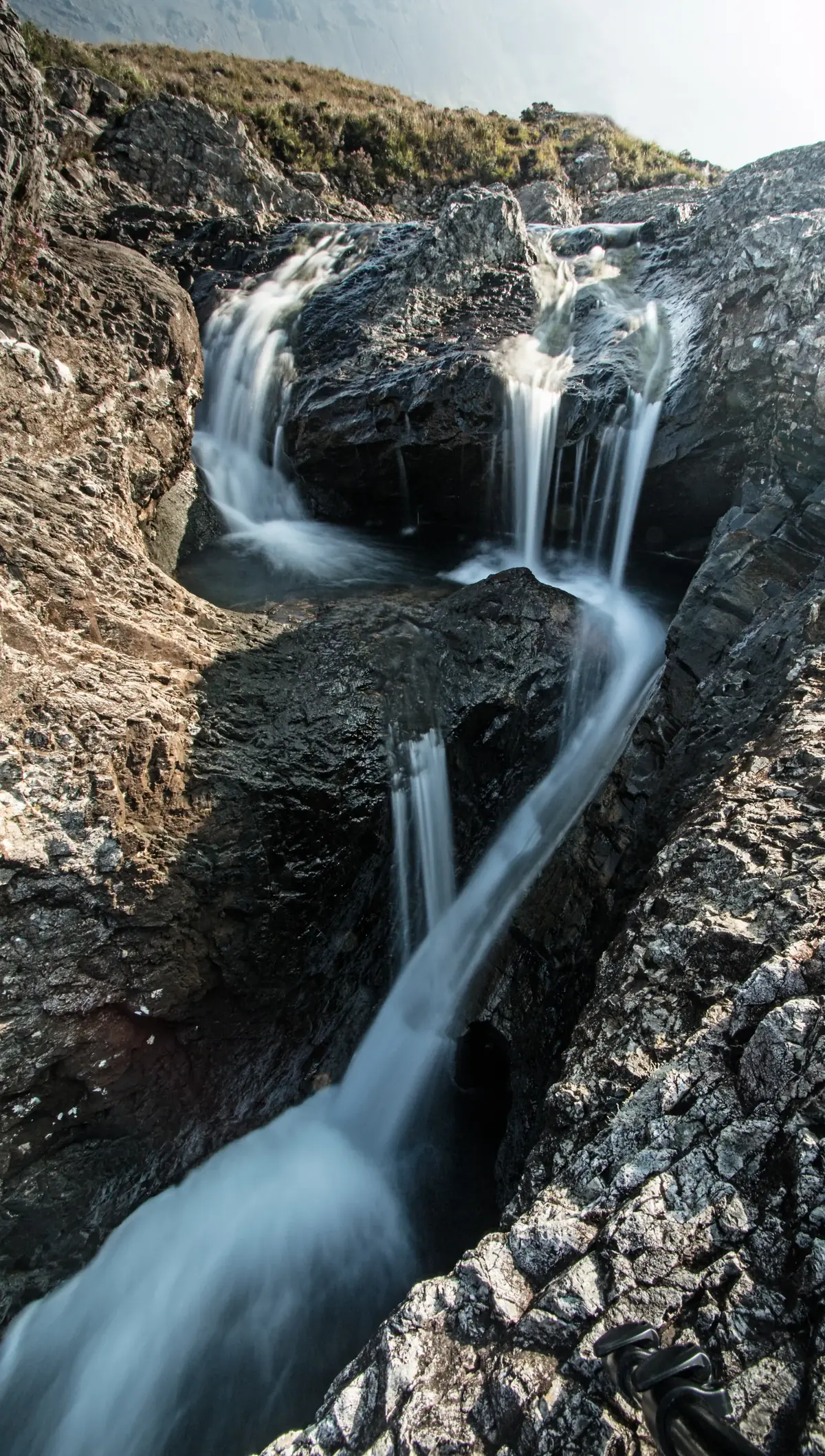
The Fairy Pools sit on the Allt Coir’ a’ Mhadaidh — “the burn of the corrie of the wolf” — at the foot of the Black Cuillin mountains in Glen Brittle, Isle of Skye (coordinates: 57°15′00″N 6°15′23″W). The first known reference to this location as “the Fairy Pools” appears in a 1931 guide book, and, according to Wikipedia, there are no actual known associations with fairies. The Battle of Coire Na Creiche — a major clan conflict between the MacLeods and the MacDonalds — was fought in this corrie in 1601, giving the landscape a history well before the tourist era. The reason so many searches include the word “purple” comes down to two separate things: a famous hoax and a seasonal natural phenomenon.
What the Fairy Pools in Glen Brittle, Isle of Skye actually look like
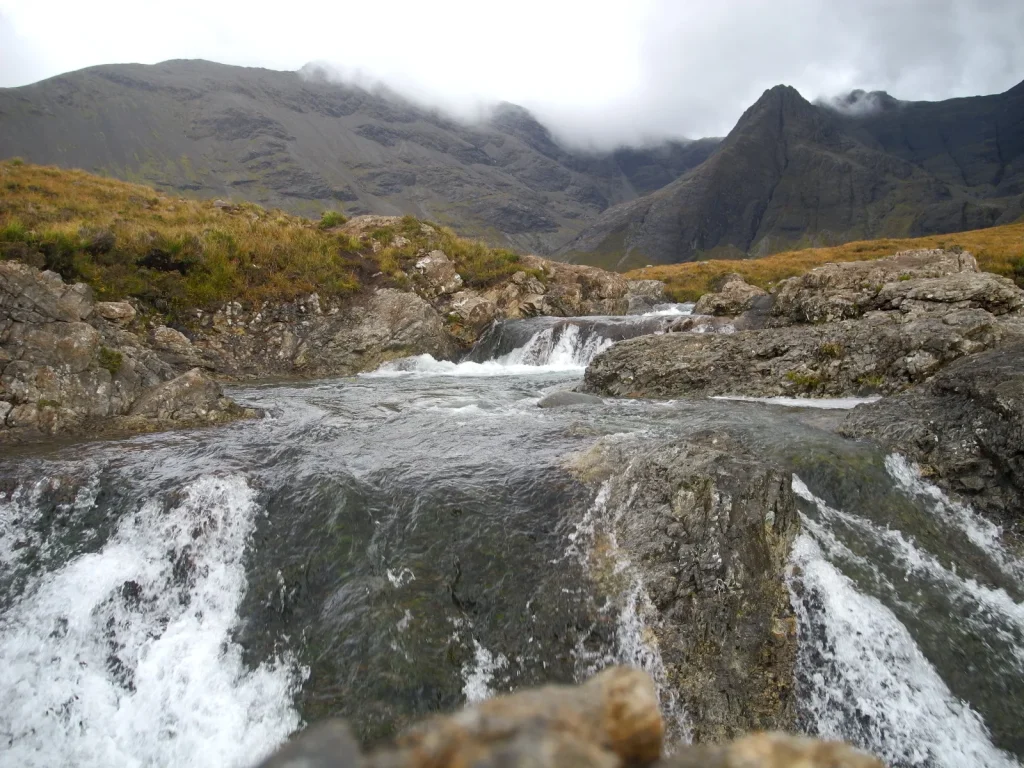
The pools are vivid aqua blue — the colour comes from exceptionally clear mountain water flowing over the dark basalt rock of the Cuillin geology, which creates the turquoise-and-teal visual effect familiar from photographs. The burn creates a chain of distinct pools and waterfalls as it descends the hillside, each pool carved by centuries of water into the rock. The first and largest waterfall feeds the deepest pool at the bottom of the walk — a popular spot for jumping and diving. A short distance upriver is the most famous pool, distinguished by a natural submerged rock arch through which confident swimmers can pass underwater. The backdrop is the Black Cuillin ridge, one of the most dramatic mountain silhouettes in Britain. The whole scene is, on a clear day, extraordinary — just not purple.
The 2013 purple hoax: why people still search for purple fairy pools
In October 2013, images circulated online showing a landscape of vivid purple-leaved trees reflected in blue water. The images were captioned as being from the Fairy Pools in Scotland, and they spread widely across Facebook and early social media. Hoax-busting site Hoaxes.org confirmed that the photographs actually showed the Shotover River in New Zealand, with the vegetation digitally colour-shifted to purple via a photo filter. The images had nothing to do with Scotland. However, the damage to the search landscape was already done: millions of people had seen “purple fairy pools Scotland” as a caption, and the phrase became a persistent search term. Wikipedia’s Fairy Pools article still notes this hoax explicitly. If you arrive at Glen Brittle expecting purple trees and purple water, you will find neither — but what you will find is considerably more real and more impressive.
When the Fairy Pools landscape genuinely turns purple: heather season
There is, however, a time when the landscape around the pools does genuinely turn purple. Scottish heather (Calluna vulgaris) blooms across the moorland of Glen Brittle and the surrounding Minginish peninsula from late July through September, colouring the hillsides in bands of purple and pink. Photographs taken in this window — particularly late August — show the vivid blue pools framed against purple heather with the dark Cuillin peaks behind: a genuinely spectacular colour combination that explains why the purple-pools idea has such visual appeal. This is also when the Fairy Pools are at their busiest, with visitor numbers peaking towards the 200,000+ annual figure recorded since 2019 and over 1,000 visitors per day at the height of the summer season.
What to Expect at the Fairy Pools: The Walk, Wild Swimming and the Arch
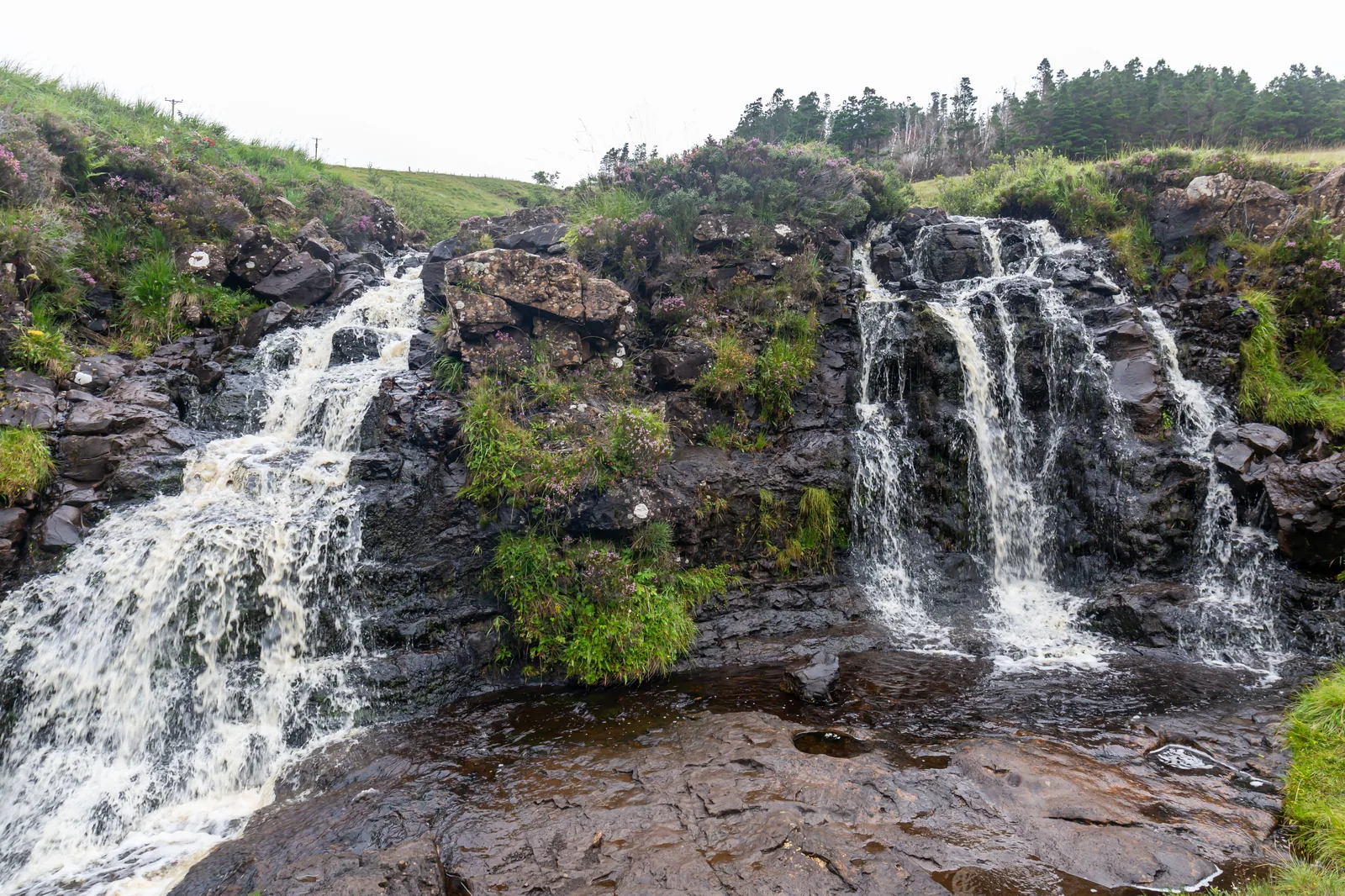
The Fairy Pools are a working wild landscape, not a managed attraction. There are no entry gates, no admission staff, no changing rooms and no lifeguards. The path is purpose-built and well maintained, but the pools are cold, the rocks are slippery when wet, and the weather on Skye changes faster than almost anywhere in Britain. Understanding the practical reality before you arrive means you can enjoy the experience rather than be surprised by it. Here is what the visit actually involves.
The 2.4km walk: route detail, footbridges and terrain
The walk begins at the Glen Brittle car park and follows a wide, firm gravel path south-west along the burn towards the base of the Cuillin. The complete return distance is 2.4km (approximately 1.5 miles), with an average completion time of 40 minutes to 1.5 hours depending on pace and how long you spend at the pools. The path crosses the burn on two footbridges; after the second bridge there is a short, steep rocky section before the terrain levels. Most walkers reach the first and largest waterfall in about 20 minutes from the car park. The path is well-marked and signposted from the car park, though it can develop boggy patches after rainfall — waterproof walking shoes or boots are strongly advised. The route is rated easy to moderate on AllTrails, with over 3,800 reviews. Many visitors walk only to the first pool; those who continue uphill encounter quieter, more remote pools with far fewer people.
Wild swimming in the Fairy Pools: temperature, the arch pool and safety
The water in the Fairy Pools is cold by any definition. Temperature stays between 8°C and 12°C year-round, rarely rising above 11°C (52°F) even in the warmest summers. This is mountain stream water fed by snowmelt and rainfall from the Cuillin ridge above — it does not warm up significantly. Swimming is permitted at your own risk throughout the year, and there are no lifeguards. A wetsuit is strongly recommended for anyone planning to spend more than a few minutes in the water; many visitors go in without one but cold-water shock is a genuine risk. The standout feature for swimmers is the pool with a natural submerged rock arch, a short distance upriver from the main waterfall. Experienced swimmers pass through the arch underwater — it is shallow enough to be safe but dramatic enough to be memorable. The first and largest pool below the main waterfall is the deepest and most popular for jumping. Visiting after heavy rainfall makes the waterfalls significantly more powerful and the pools deeper, but also increases the current strength, so judge conditions carefully. For other wild swimming options in the UK, our guide to natural swimming pools covers comparable freshwater spots.
How many Fairy Pools are there and which are the best ones
There is no official count of the Fairy Pools. The name covers a continuous series of natural pools and waterfalls along the Allt Coir’ a’ Mhadaidh burn rather than a defined number of separate sites. Most walkers on the standard 2.4km route encounter five to eight distinct swimming pools in the lower section of the burn. The two most photographed are: (1) the wide shallow turquoise pool at the base of the main waterfall — the classic “arrival” shot; and (2) the arch pool a short walk upriver, which appears in almost every wild-swimming photograph of the site. Extending the walk further uphill beyond the standard turning point reveals additional, less-visited pools, including some with better seclusion and comparable clarity. These upper pools attract fewer day-trippers and more serious hikers. The Wikipedia entry confirms the pools are “a series” rather than a countable set, which also answers the common search query “how many fairy pools are there in Scotland.”
Getting to the Fairy Pools: Parking, Transport and the Best Times to Visit
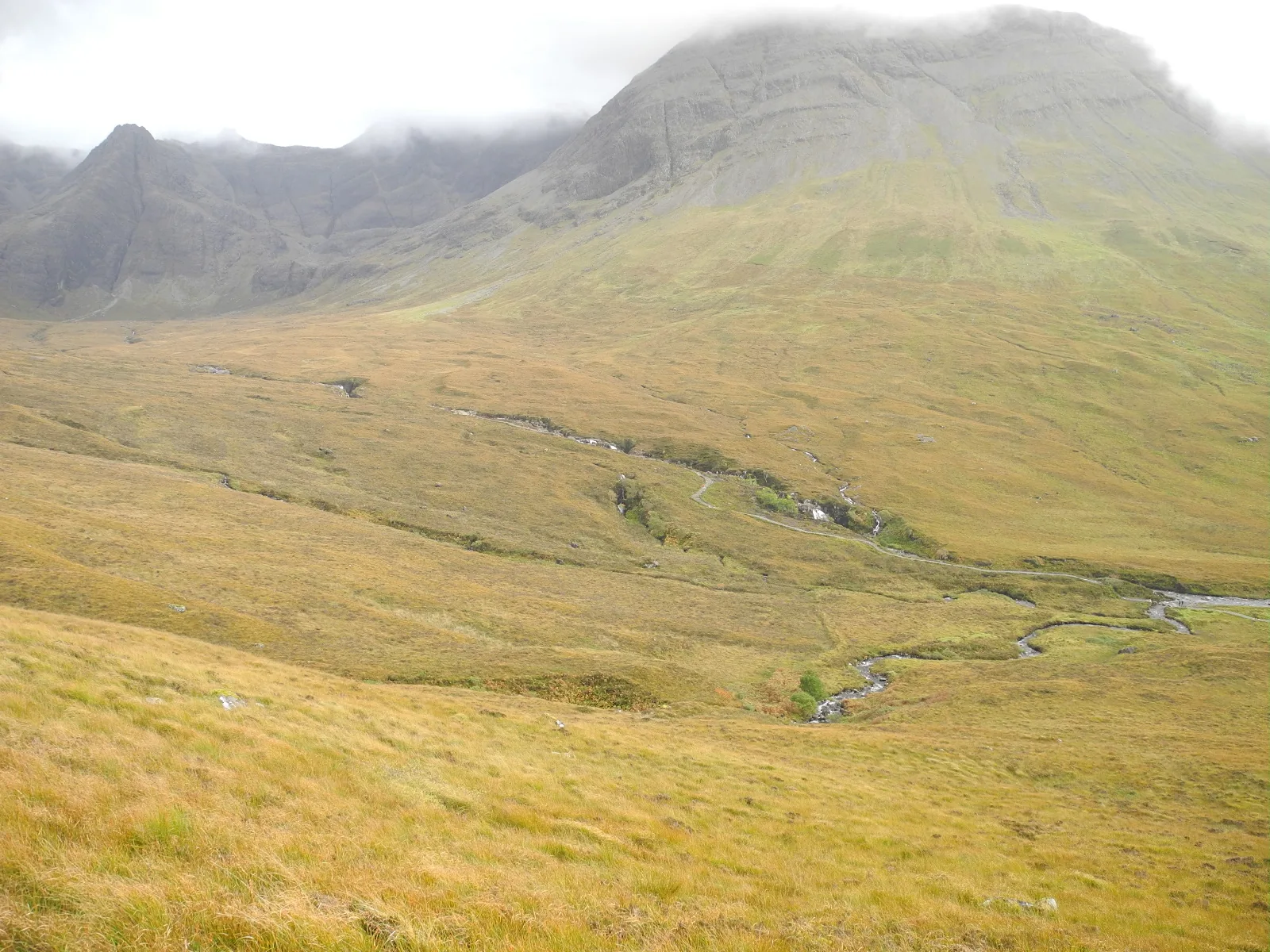
The Fairy Pools are on the Isle of Skye, which means every visit involves crossing to the island — either via the Skye Bridge at Kyle of Lochalsh or by the CalMac ferry to Armadale from Mallaig. Once on the island, Glen Brittle is in the west, off the B8009, and there is no public transport that goes directly to the car park. A car is the most practical way to visit. Here is the logistics in detail.
Parking at the Fairy Pools: the 120-space car park and £6 fee
For years the Fairy Pools had no dedicated parking and visitors were parking on verges, causing damage and congestion. In 2020, the Minginish Community Hall Association completed a purpose-built car park at a cost of £800,000, funded through various tourism and community grants. The car park has 120 spaces, charges £6 per day via pay-and-display, and includes an off-grid toilet block with facilities for men, women and disabled visitors. It is managed by the Outdoor Access Trust for Scotland. In the peak season (July–August), the car park can fill by mid-morning, so arriving early is essential. The pools themselves are free to visit — there is no entry charge. A small area of informal parking further up the hill is used by some visitors as a free alternative, but adds distance to the walk. The entry to Skye via the Skye Bridge is also now toll-free.
How to reach the Isle of Skye from Edinburgh, Glasgow and Inverness
From Edinburgh: the driving distance is approximately 238 miles, taking around 4 hours 30 minutes via the A9 and A87 to Kyle of Lochalsh, then over the Skye Bridge. By public transport, the best option is bus via Inverness, taking approximately 7 hours 30 minutes.
From Glasgow: the most scenic route is the West Highland Line from Glasgow Queen Street to Mallaig, passing through Rannoch Moor and Fort William. From Mallaig, the CalMac ferry crosses the Sound of Sleat to Armadale on Skye (approximately 30 minutes). A hire car from Armadale is then needed to reach Glen Brittle. The drive from Glasgow to Kyle of Lochalsh is approximately 3 hours 30 minutes.
From Inverness: a ScotRail train to Kyle of Lochalsh takes approximately 2 hours 40 minutes, but there is no public bus that goes directly from Kyle to Glen Brittle car park. A hire car from Kyle of Lochalsh or a pre-booked taxi is necessary for the final leg. Guided day tours from Inverness and Portree are available and are a viable option for those without a car.
Best time to visit and how to avoid the 200,000-strong annual crowd
The Fairy Pools have gone from a quiet local secret — 13,000 visitors in 2006 — to a major tourist attraction with over 200,000 visitors annually by 2019, with peak days exceeding 1,000 visitors. Managing crowds is now a genuine challenge. The most effective strategies:
- Arrive before 9 AM or after 5 PM in peak season — the car park is often full by mid-morning in July and August.
- May and June offer better weather than April, fewer crowds than July–August, and no heather (green hillsides rather than purple).
- August–September is heather season — the landscape genuinely turns purple and the blue pools look spectacular against it, but this is the busiest window.
- Avoid midges (tiny biting insects): worst from June to August, particularly around dawn and dusk and in still, damp weather. A DEET repellent is essential if visiting in this window.
- Winter visits are quieter but the path can be icy, spate conditions can make waterfalls dangerous, and the water temperature drops further. The landscape has a bleaker beauty but requires more preparation.
What surprises most people about the “purple fairy pools” story is that the phrase that brings 300,000+ annual searches to it globally traces back to a single 2013 Facebook post showing images of New Zealand with a colour filter. The actual Fairy Pools have never been purple — but in late August, standing at the edge of the arch pool with the Black Cuillin reflected in the turquoise water and the heather-covered hillsides running purple in every direction, they are something considerably better than a viral hoax. Set your alarm for 6:30 AM, arrive at Glen Brittle car park by 7:30 AM in August, and you will have both the genuine purple heather landscape and the famous blue pools almost entirely to yourself before the daily visitor peak begins.
Frequently Asked Questions
Why are they called “purple fairy pools Scotland”?
The phrase comes from a 2013 internet hoax: viral images of a digitally colour-filtered New Zealand river were falsely captioned as Scotland’s Fairy Pools. Millions saw “purple fairy pools Scotland” as a caption, making it a persistent search term. The real pools are vivid aqua blue.
Are the Fairy Pools on the Isle of Skye actually purple?
No. The water is vivid aqua blue. However, in August and September Scottish heather blooms purple across the surrounding moorland, so photos taken in that window show blue pools framed by a genuinely purple landscape — which is spectacular and entirely real.
How many Fairy Pools are there in Scotland?
There is no official count. The Fairy Pools are a continuous series of natural pools and waterfalls along the Allt Coir’ a’ Mhadaidh burn in Glen Brittle, Isle of Skye. Most walkers on the standard route encounter five to eight distinct swimming pools, with more available by extending the walk uphill.
Can you swim in the Fairy Pools on Skye?
Yes — swimming is free and permitted year-round at your own risk. Water temperature stays 8–12°C (rarely above 11°C) so a wetsuit is strongly recommended. There are no lifeguards. The most famous swim feature is a natural submerged rock arch you can pass through underwater.
Is there parking at the Fairy Pools and is it free?
A dedicated 120-space car park opened in 2020 at a cost of £800,000. It charges £6 per day via pay-and-display and includes toilets. The pools themselves are free to enter — only the car park charges a fee. In peak season, the car park fills by mid-morning.
How far are the Fairy Pools from Edinburgh?
Approximately 238 miles by road, taking around 4 hours 30 minutes to drive. By public transport (bus via Inverness) the journey takes approximately 7 hours 30 minutes. The nearest station is Kyle of Lochalsh, from which you need a hire car or taxi to reach Glen Brittle car park.