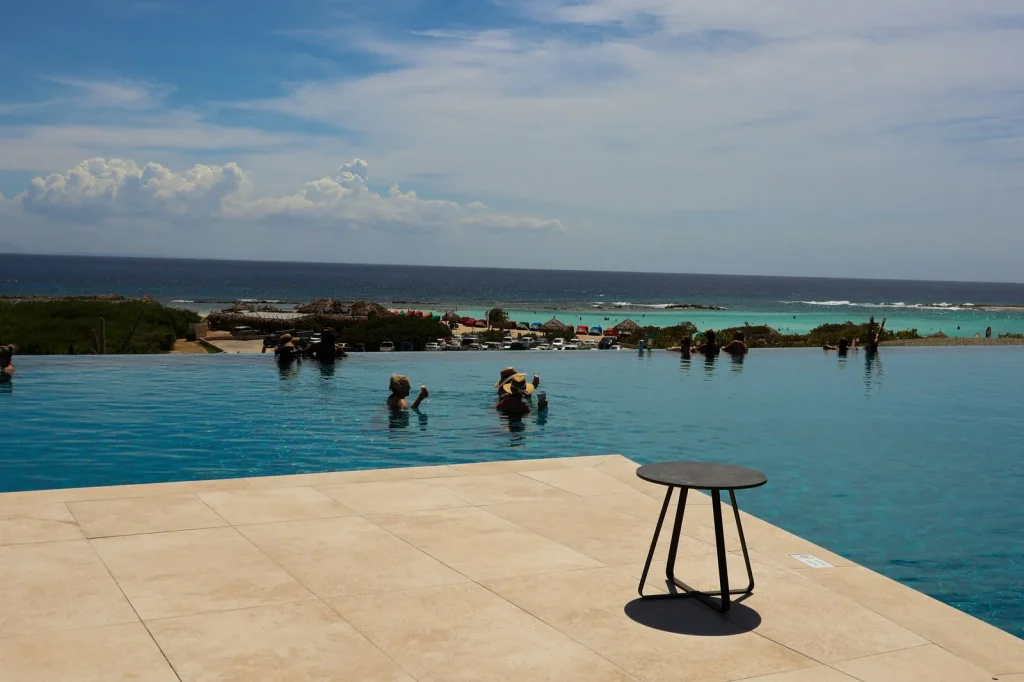
An infinity pool works by continuously circulating water over a vanishing edge into a hidden catch basin below, from which powerful pumps return it through a filtration system and back into the main pool. The visual effect — water appearing to merge with the horizon or surrounding landscape — is produced by aligning the overflow edge precisely at water surface level. Achieving this requires, in engineering terms, two separate hydraulic circuits in one structure: the standard pool filtration circuit, and a dedicated overflow recirculation circuit. This guide explains each component of the system and what it costs to build one.
- The vanishing edge is positioned exactly at the pool’s water surface level. Water spills over this edge into a trough or catch basin hidden just below the rim, then returns to the main pool via a dedicated recirculation pump.
- Infinity pools require two pump circuits: one for standard pool filtration, and a second dedicated to drawing overflow water from the balance tank and recirculating it back to the pool.
- Marina Bay Sands in Singapore has the world’s longest elevated infinity pool: a 146-metre (479ft) vanishing edge, 191 metres (627ft) above street level, holding 376,500 gallons (1,425m³) of water. Four movement joints allow up to 500mm of flex across the towers.
- Residential infinity pools in the UK cost £110,000–£250,000; in the US, the average is $95,000 ($80/sq ft). Adding an infinity edge to a standard pool typically adds $25,000–$50,000 to the build cost.
The Overflow Edge and Catch Basin: How the System Works

The defining engineering feature of an infinity pool is its vanishing edge — one or more sides of the pool where the wall is built to the exact level of the water’s surface. As the pool’s recirculation system continuously introduces water, the surface rises to the rim level and spills over in a controlled cascade. This creates the appearance that the water has no boundary, merging visually with whatever lies beyond: an ocean, valley, or skyline.
The Overflow Edge
The overflow edge requires extremely precise alignment during construction. Even minor miscalculations in the wall height compromise the visual effect — too high and a concrete lip becomes visible; too low and the water sheet becomes uneven. Platinum Pools explains that the pump flow rate is calculated based on the edge’s length and the expected number of swimmers, since bathers entering the pool displace volume that adds to the overflow rate.
The Catch Basin and Balance Tank
Hidden just below the vanishing edge is a catch basin or trough — typically a concrete channel running the full length of the overflow side. Water cascading over the rim collects here before flowing by gravity into a balance tank (also called a surge tank or reservoir), which acts as a buffer reservoir for the recirculation system. The balance tank absorbs normal fluctuations in pool volume: water displacement from swimmers, rain, evaporation and splash loss all affect the rate at which water spills over the edge. By absorbing these variations, the tank maintains a consistent, smooth overflow at all times.
Sizing the catch basin and balance tank correctly is critical to system performance. The tank must be large enough to handle peak-flow conditions — when multiple swimmers enter simultaneously, the displacement surge can significantly increase overflow volume — while never running dry, which would interrupt the pump and damage it. Compass Pools notes that high-volume pumps are essential because the recirculation circuit handles large quantities of water on a continuous basis.
The Recirculation Pump and Filtration Circuit
Infinity pools require two independent pump circuits:
- Circuit 1 — main pool filtration: draws water from the pool floor and walls, passes it through the sand or cartridge filter, then returns it to the pool. This is identical to the circuit in a standard inground pool.
- Circuit 2 — overflow recirculation: draws water from the balance tank, passes it through its own filtration stage, and pumps it back into the main pool via inlets on the floor and walls, maintaining the water level that produces the overflow effect.
A water level controller — typically a solenoid valve combined with a float sensor in the balance tank — automatically tops up the system with mains water when the tank drops below the minimum operating level. Without this, evaporation or prolonged overflow would eventually run the tank dry and stop the circuit.
Infinity Pool Costs and Engineering Requirements
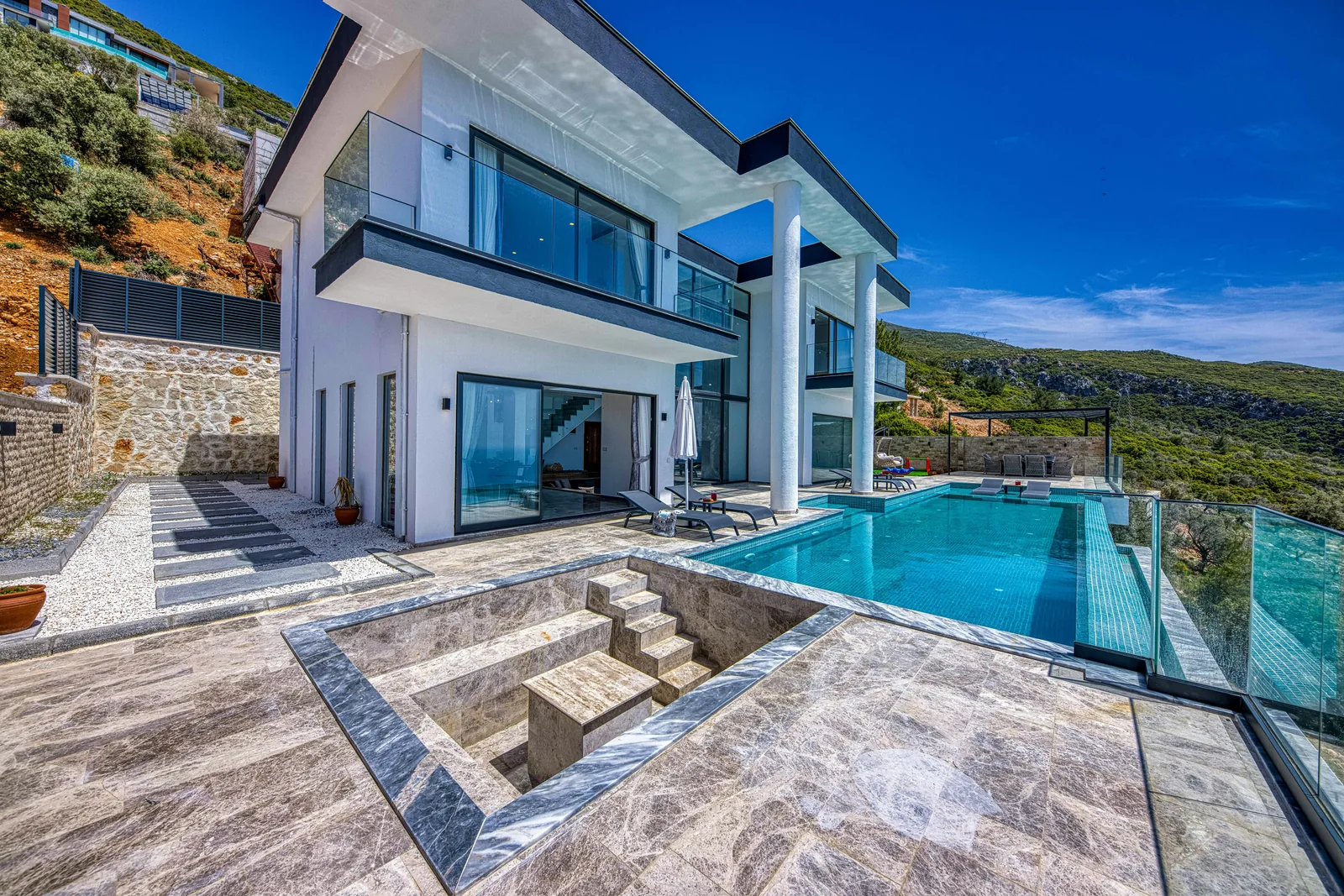
An infinity pool is, in engineering terms, two pools in one — the main basin and the overflow/recirculation system below it. For an overview of types of swimming pools including overflow, overflow-overflow and skimmer pool classifications, see our separate guide. This structural complexity, combined with the precision required for edge alignment and the additional hydraulics, makes infinity pools significantly more expensive to build and maintain than standard inground pools.
Construction Costs
In the UK, residential infinity pools typically cost £110,000–£250,000 to build. In the US, the average is around $95,000 (approximately $80 per square foot), with a range from $55,000 for simpler designs to $200,000+ for larger or structurally complex builds. HomeAdvisor’s 2025 data puts the premium for adding an infinity edge at $25,000–$50,000 over the cost of an equivalent standard inground pool. The three main cost drivers are: the catch basin construction, the second pump and hydraulic circuit, and the precision engineering required for the overflow edge.
The World’s Largest: Marina Bay Sands
Marina Bay Sands SkyPark in Singapore holds the record for the world’s longest elevated infinity pool: a 146-metre (479ft) vanishing edge, positioned 191 metres (627ft) above street level on top of three hotel towers. The pool holds 376,500 US gallons (1,425 cubic metres) of water and is constructed from 422,000 pounds (191,000kg) of stainless steel. Four movement joints beneath the pool structure accommodate the natural flexion of the towers, with a total range of motion of 500 millimetres (20 inches). Access is restricted to hotel guests. The wider Marina Bay Sands development, which opened in 2010, cost S$8 billion (approximately US$6.88 billion).
Running Costs and Maintenance
Infinity pools have higher annual running costs than standard pools because the overflow recirculation circuit adds pump energy consumption, and the increased water surface area (including the catch basin) increases evaporation and chemical demand. UK running costs typically range from £1,500–£5,000 per year, depending on pool size, heating, and usage. The overflow trough, balance tank, and pump system require regular inspection and cleaning to prevent blockages that could disrupt water flow or damage the pumps. The water level controller and solenoid valve should be tested periodically to ensure the auto-refill function operates correctly.
| Component | Function | Key Requirement |
|---|---|---|
| Vanishing edge | Creates the overflow visual effect | Precisely level with pool water surface |
| Catch basin / trough | Collects overflow water from rim | Full-length coverage; sized for peak flow |
| Balance tank | Buffers volume variation from swimmers, evaporation, rain | Large enough to prevent pump dry-running |
| Overflow pump circuit | Returns water from tank to main pool | Second dedicated pump (in addition to main filter pump) |
| Water level controller | Auto-refills tank from mains when level drops | Solenoid valve + float sensor |
Frequently Asked Questions
How does an infinity pool work?
An infinity pool works through a continuous recirculation cycle. Water fills the pool to the exact level of the vanishing edge, then spills over into a hidden catch basin below. From there, it flows by gravity into a balance tank, where a dedicated pump draws it through filtration and returns it to the main pool. This closed-loop system maintains a constant overflow while recycling the same water.
Why do infinity pools cost more than standard pools?
Infinity pools cost more because they require two separate hydraulic circuits (main pool filtration plus overflow recirculation), a catch basin and balance tank beneath the overflow edge, precision construction to align the vanishing edge exactly at water surface level, and a second pump for the overflow circuit. In the UK, a residential infinity pool costs £110,000–£250,000; in the US, adding an infinity edge typically adds $25,000–$50,000 to a standard pool build.
Where does the water go in an infinity pool?
The water that flows over the vanishing edge falls into a catch basin or trough hidden below the pool rim. This trough connects to a balance tank (reservoir), from which a pump returns the water through filtration and back into the main pool. No water is lost — it is continuously recycled in a closed circuit. The balance tank also buffers the volume displaced by swimmers entering the pool.
What is a balance tank in an infinity pool?
A balance tank (or surge tank) is a reservoir positioned below the infinity pool’s overflow edge. It collects water that cascades over the vanishing edge and acts as a buffer to absorb volume fluctuations — from swimmers, evaporation, rainfall and splash. A pump draws water from the balance tank, passes it through a filtration system, and returns it to the main pool. The balance tank also houses the water level controller that automatically tops up the pool from mains water when needed.
What is the world’s largest infinity pool?
Marina Bay Sands SkyPark in Singapore has the world’s longest elevated infinity pool: a 146-metre (479ft) vanishing edge positioned 191 metres (627ft) above street level. The pool holds 376,500 gallons (1,425m³) of water, is built from 422,000 pounds of stainless steel, and spans three hotel towers connected by a 340-metre skybridge. Four movement joints allow the pool structure to flex up to 500mm with tower motion.
Can you have an infinity pool at home in the UK?
Yes — residential infinity pools are built across the UK, typically costing £110,000–£250,000 depending on size, materials and site conditions. A hillside or elevated garden position maximises the visual effect. Annual running costs range from £1,500–£5,000. Planning permission requirements vary by local authority — pools are generally permitted development for most UK residential gardens, but you should check with your local council if the pool is in or near a listed building, conservation area, or Area of Outstanding Natural Beauty.