Pool depth varies significantly depending on the type of pool and what it is designed for. A UK leisure centre pool typically runs from 0.9 metres at the shallow end to 1.8 metres at the deep end. An Olympic competition pool must be at least 2 metres deep throughout. A residential pool designed for family use usually sits between 1.2 and 1.6 metres. This guide covers the standard depths for each pool type, what different activities require, and how to think about depth when planning a home pool.
- UK leisure centre pools typically range from 0.9m (shallow end) to 1.8m (deep end)
- Olympic competition pools must be a minimum of 2 metres deep, with 3 metres recommended by World Aquatics
- Swim England updated minimum racing start depth guidance in September 2023: 1.35m is now required, extending at least 6 metres from the end wall
- Residential family pools typically have a shallow end of 1.1–1.2m and a deep end of 1.5–1.8m
Standard Pool Depths in the UK
Public leisure centre pools
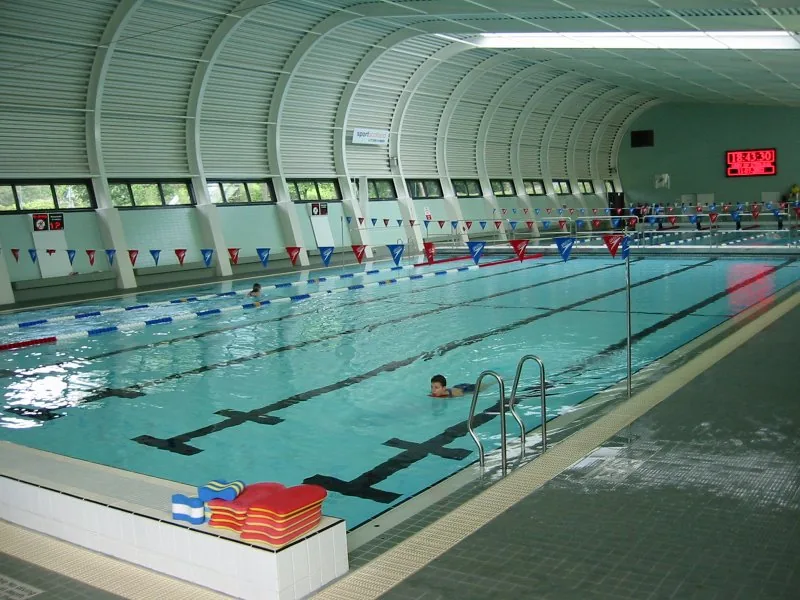
The majority of public swimming pools in the UK are 25-metre short-course pools. Their depth profile follows a predictable pattern: a shallow end starting at 0.9–1.0 metres, rising slightly in the teaching bay or learner zone, and a deeper section at 1.6–1.8 metres toward the opposite end. The 1.8-metre deep end is the standard in UK public pools because it allows for lifesaving practice, shallow racing dives, and water polo training — all of which require at least 1.8 metres according to Swim England’s activity depth guidance.
Many leisure centres also have a separate learner or teaching pool, which is shallower throughout — typically 0.9–1.0 metres from end to end. These are designed for beginner lessons, children, and non-swimmers. Some leisure pools designed for family recreation include a beach-entry zone starting at 0–0.3 metres, rising gradually to 1.0 metres, alongside a separate main pool at adult depths.
Olympic and competition pools
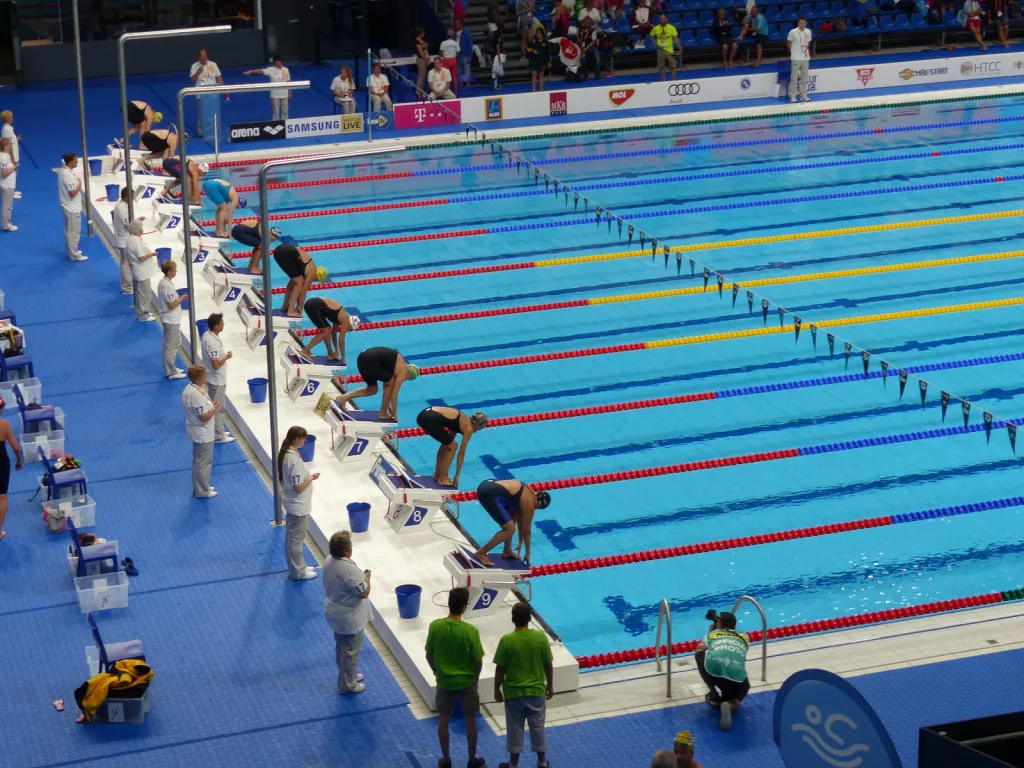
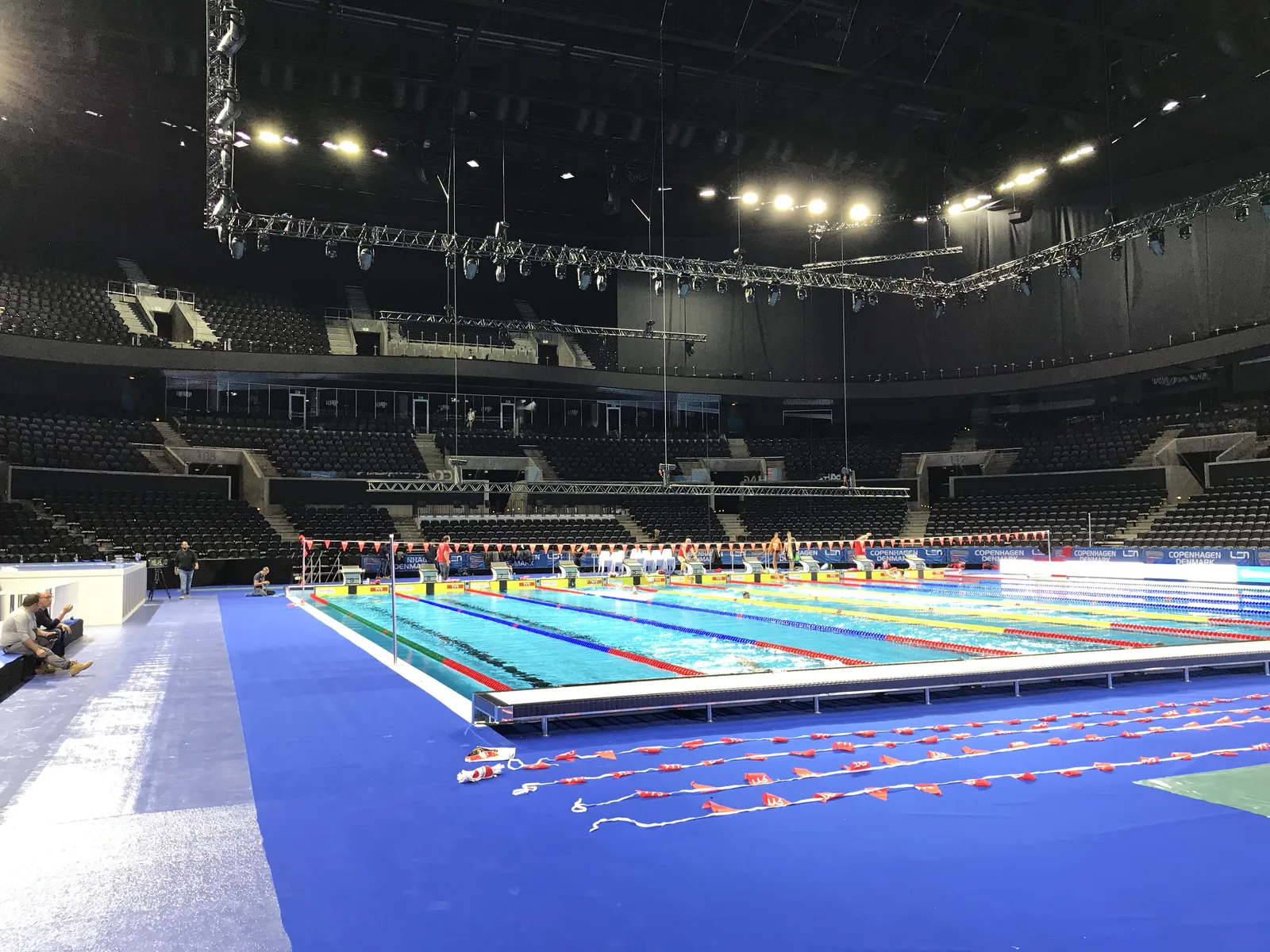
Olympic and World Championship pools must comply with World Aquatics (formerly FINA) regulations, which specify a minimum depth of 2 metres throughout the pool. For events combining swimming with artistic swimming or other disciplines, 3 metres is recommended to accommodate underwater activity without risk. The 50-metre pool built at Sandwell Aquatics Centre for the 2022 Birmingham Commonwealth Games meets these standards, with a movable floor system that allows depth to be adjusted for different events and programme uses.
At the starting block end of competition pools, the minimum depth requirement is 1.35 metres extending from 1.0 metre to at least 6.0 metres from the end wall — a specification updated by Swim England in 2023. This change was driven by safety evidence that racing dives into shallower water carry a higher risk of head and neck injury, particularly for taller swimmers who enter the water at a steeper angle.
Outdoor and lido pools
Outdoor lidos and open-air pools in the UK vary more in depth than indoor facilities because many were built in the mid-20th century before standardised guidance. Some historic lidos, such as Parliament Hill Lido in London, have depths of 0.9 metres throughout with no deep end — designed for safe recreational splashing rather than competitive swimming. More recently constructed outdoor pools follow the same 0.9–1.8m profile as indoor leisure centres. Wild swimming locations in rivers, lakes, and tarns have no controlled depth — they can range from a few centimetres to many metres, depending on the specific site.
Depth Requirements for Different Activities
Recreational swimming and lane swimming
General recreational swimming does not require deep water. Swim England guidance specifies 0.9 metres as the functional minimum for adults swimming for fitness or leisure, with 1.0 metre preferred. At 1.0 metre, an average adult swimmer can stand comfortably without crouching, which allows rest, pushing off from the bottom, and general ease in the water. Lane swimming in most UK pools takes place in the main pool section at 1.0–1.8 metres — the depth is largely irrelevant to technique beyond ensuring the swimmer cannot touch the bottom during the stroke cycle, which requires at least 1.0–1.2 metres for a standing adult.
Hot tub and spa pools operate at much shallower depths — typically 0.8–1.1 metres — because they are designed for seated relaxation rather than swimming. The shallower depth allows jets and seating to be positioned effectively without requiring large volumes of water to heat and treat.
Diving and racing starts
Depth becomes safety-critical for any activity involving entering the water headfirst. For racing starts from starting blocks (competitive dives), Swim England now requires a minimum depth of 1.35 metres — this applies to all affiliated clubs in the UK and represents the most significant recent update to pool use rules. For teaching shallow racing dives as a technique skill, 1.8 metres is the recommended minimum. Recreational jumping from poolside is generally considered safe at 1.5 metres or more, although most public pools prohibit jumping for liability reasons regardless of depth.
Springboard and platform diving require far greater depths. A 1-metre springboard requires a minimum pool depth of approximately 3.4 metres directly below the board. A 3-metre springboard needs at least 3.8 metres of water depth. A 10-metre platform — the highest used in Olympic competition — requires a pool at least 5 metres deep beneath it. Dedicated diving pools are a distinct facility from swimming pools; the UK has relatively few, with the largest at the London Aquatics Centre in Stratford and the Plymouth Life Centre.
Children’s teaching pools and paddling areas
Learner pools designed specifically for children’s swimming lessons typically hold water at 0.6–0.9 metres. At this depth, a child of average primary school height (1.1–1.2 metres) can stand with their head clear of the water, which builds confidence and allows teachers to assist students safely without needing to swim themselves. Dedicated paddling pools or splash pads for very young children are shallower still — 0.2–0.4 metres — and are designed for supervised play rather than swimming. Water polo and sub-aqua training both require a minimum of 1.5 metres, and lifesaving practice requires 1.8 metres, according to Swim England’s published activity-depth framework.
How Deep Should a Residential Pool Be?
Typical depths for home pools in the UK
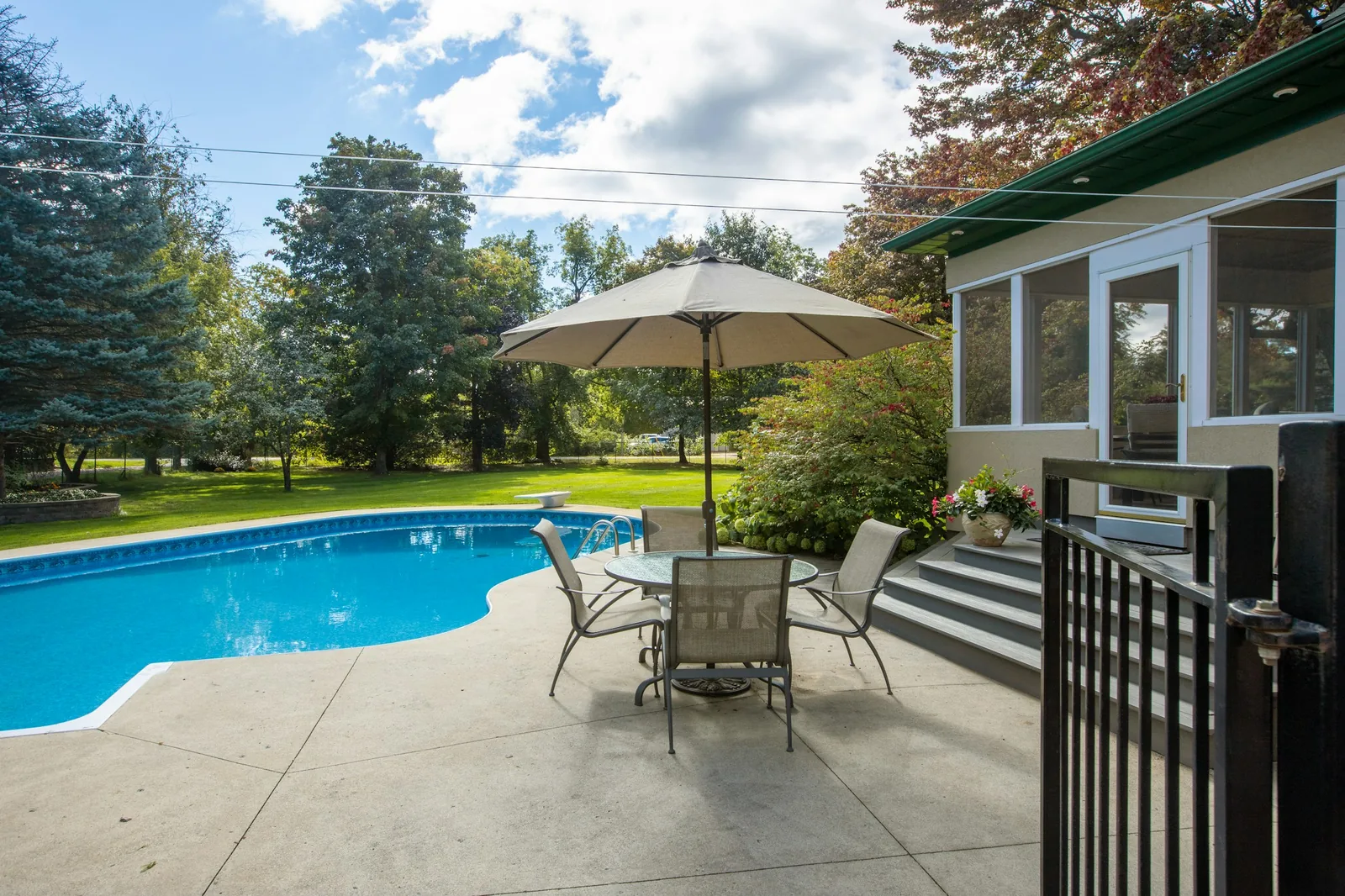
For a standard residential pool used by a family with mixed ages and abilities, the most functional design runs from a shallow end of 1.1–1.2 metres to a deep end of 1.5–1.8 metres. This range suits adult lap swimming, children learning to swim, jumping in from the side, and general recreation. UK pool builders such as Compass Pools recommend a maximum deep end of 1.5–1.6 metres for family pools where young children will be the primary users, deepening to 1.8 metres where adults want to swim laps and practise lifesaving skills.
A uniform depth throughout the pool — rather than a sloping profile — is increasingly common in smaller residential pools because it maximises usable space and simplifies construction. A pool held at a consistent 1.35–1.5 metres throughout suits recreational swimming, stands comfortably for most adults, and avoids the cost of excavating a deep end section.
When a deeper pool is worth it
If the pool will be used for diving from poolside, a minimum depth of 2.0 metres at the point of entry is strongly recommended. Adding a diving board to a residential pool requires 2.4–3.0 metres of clear water below the board, and in the UK, planning permission and Building Regulations compliance are typically required before a diving board can be installed. Most UK residential pool installations do not include diving boards, partly for safety reasons and partly because the additional depth increases excavation costs significantly — digging 3 metres down rather than 1.8 metres roughly doubles the earthworks cost for that section of the pool.
For serious lap swimmers who want to train rather than just exercise, a constant depth of 1.8 metres throughout the pool allows for proper tumble turns without risk of touching the bottom mid-turn. This is the depth Sports England guidance identifies as appropriate for competitive training in short-course pools. If the pool will host water polo or sub-aqua sessions, 1.8–2.0 metres is the practical minimum.
Cost and safety implications of depth
Every extra 0.3 metres of depth adds material cost — more excavation, more concrete or liner material, and a larger volume of water to heat, treat, and maintain. A 25,000-litre pool at 1.2 metres depth requires meaningfully less energy to heat than a 40,000-litre pool at 1.8 metres. For most UK homeowners who want a pool primarily for summer family use, a shallower design (1.2–1.5m) represents better value than going deeper unnecessarily. Depth should match the intended use: a pool primarily for children should not have an unguarded 1.8-metre deep end, and a pool used mainly for fitness lap swimming should not be so shallow that tumble turns are impractical.
UK pool installations must comply with HSE guidance on managing health and safety in swimming pools, which requires clear depth markings on the pool edge and walls, a visible transition line between shallow and deep zones, and appropriate fencing and covers for any domestic pool to prevent unsupervised access by children.
For more context on UK public pool options, see our guide to the best swimming pools in Birmingham and our outdoor swimming pools near you guide covering lidos and outdoor facilities across the UK.
Frequently Asked Questions
What is the average depth of a swimming pool in the UK?
UK public leisure centre pools typically range from 0.9 metres at the shallow end to 1.8 metres at the deep end. The average depth across the pool is around 1.2–1.4 metres. Residential pools tend to have a similar profile, though many home pools hold a consistent 1.3–1.5 metres throughout. Olympic competition pools are significantly deeper, at a minimum of 2 metres.
How deep is an Olympic swimming pool?
World Aquatics (formerly FINA) requires Olympic pools to be a minimum of 2 metres deep throughout. For combined events including artistic swimming, 3 metres is recommended. The 50m pool at Sandwell Aquatics Centre in Birmingham, built for the 2022 Commonwealth Games, meets these standards and has a movable floor for adjustable depth. Olympic pools are also 50 metres long and 25 metres wide.
What is the minimum pool depth for diving?
For competitive racing starts from starting blocks, Swim England requires a minimum depth of 1.35 metres extending at least 6 metres from the end wall (updated guidance from September 2023). For teaching shallow racing dives safely, 1.8 metres is recommended. For recreational diving from poolside, 2.0 metres is the safe minimum. Springboard diving requires 3.4–3.8 metres depending on board height; a 10-metre platform needs at least 5 metres of water depth.
Is 1.2 metres deep enough to swim in?
Yes — 1.2 metres is a practical swimming depth for most adults. It allows for freestyle, breaststroke, and backstroke without touching the bottom during the stroke. Tumble turns become more difficult at this depth, and racing dives should not be attempted. Most UK teaching pools and many shallow leisure pools operate at 0.9–1.2 metres without issue for recreational swimming.
How deep are hotel and gym swimming pools?
Hotel and gym pools in the UK are typically 1.0–1.5 metres deep throughout, with no deep end. This uniform, shallower profile suits lap swimming, aqua fitness, and casual use without requiring the excavation and water volume of a variable-depth pool. Spa pools and hot tubs attached to leisure facilities are usually 0.8–1.1 metres deep, designed for seated use rather than swimming.