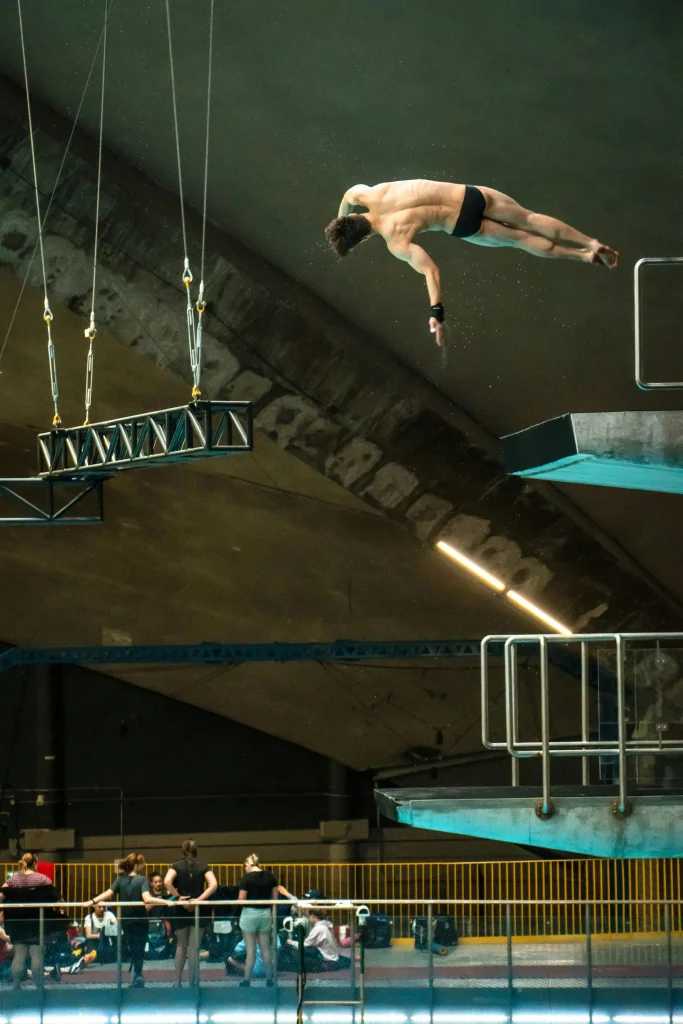
Olympic diving pools are a minimum of 5 metres (16.4 feet) deep — the depth specified by World Aquatics (formerly FINA) for pools hosting competition from 10-metre platform diving. The minimum is set by physics: a diver entering water from a 10-metre platform reaches the water at approximately 50 km/h, and the pool depth must be sufficient to decelerate safely without the diver reaching the pool floor. This guide explains the depth requirements for each level of diving, from Olympic platforms to recreational springboards, and why the specific depths are set where they are.
- Olympic 10-metre platform pools: minimum 5 metres deep (World Aquatics requirement) — many modern venues exceed this, with depths of 5.5–6 metres
- 3-metre springboard pools: minimum 4 metres deep (World Aquatics/FINA specification)
- 1-metre springboard pools: minimum 3.5 metres deep (approximately 11.5 feet)
- The depth requirement increases with platform height because higher dives produce greater entry speed — a diver from 10m enters the water at approximately 50 km/h, requiring significantly more water to decelerate safely than a 1m springboard entry
Olympic Diving Pool Depth — 10-Metre Platform Requirements
The 5-metre minimum and why it exists
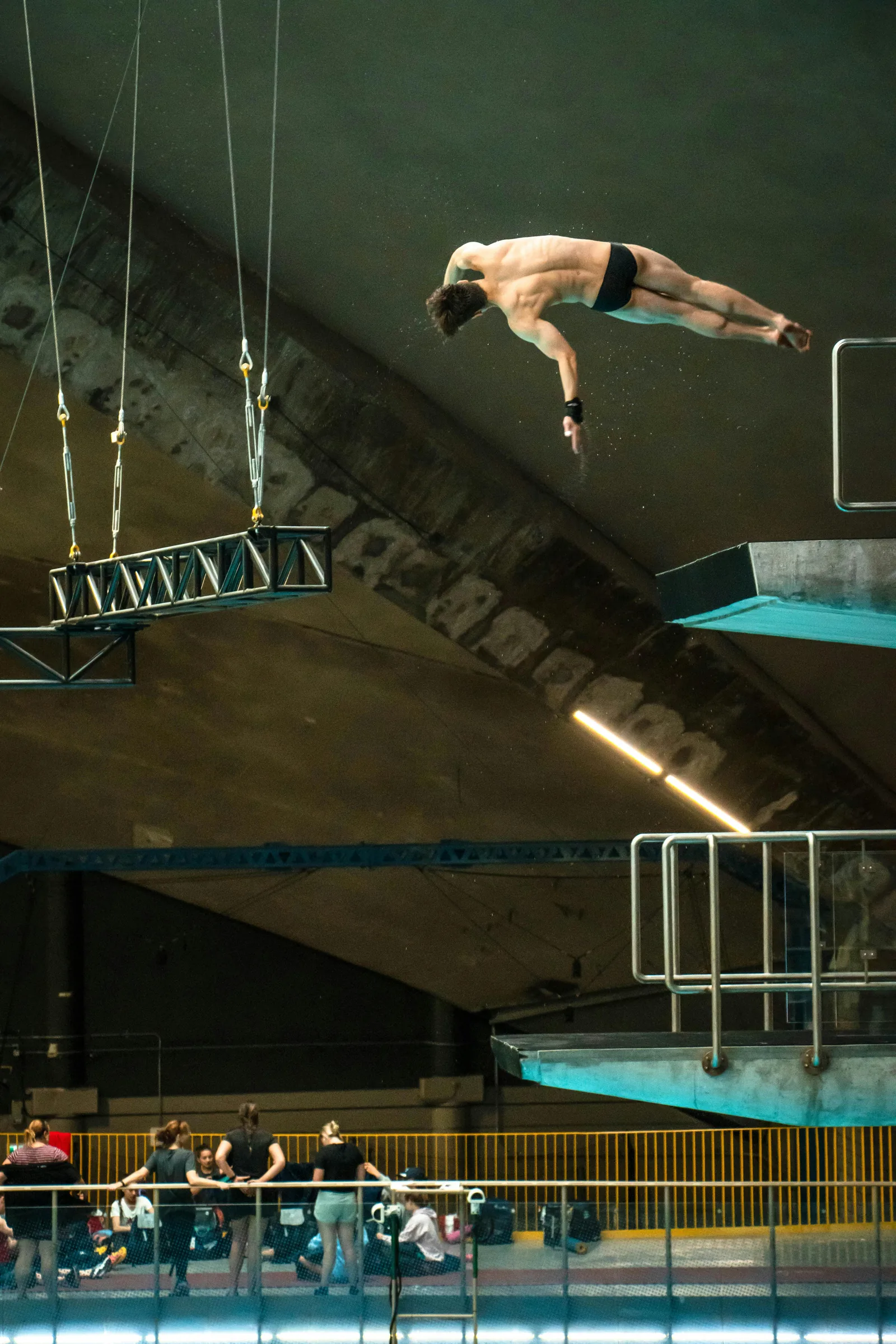
World Aquatics (the international governing body for aquatic sports, formerly FINA) specifies that diving pools for 10-metre platform competition must have a minimum depth of 5 metres (16.4 feet). This figure is not arbitrary — it is derived from the physics of entry speed and safe deceleration. A diver leaving a 10-metre platform enters the water at approximately 50 km/h (31 mph). At that speed, stopping distance in water — the distance required to decelerate to safe velocity without hitting the pool floor — requires a minimum of around 4–5 metres of water depth below the entry point. The 5-metre specification provides this clearance with a margin of safety. According to SwimOutlet’s guide to diving pool dimensions, the World Aquatics rules additionally require that the depth of the diving pool shall not be less than 1.8 metres at any point — the competition zone requires the full 5 metres, but even the pool’s periphery must maintain a minimum depth throughout.
Modern Olympic and World Championship diving pools frequently exceed the 5-metre minimum. Venues built or refurbished for recent Games have been constructed to 5.5–6 metres depth — the additional depth is not required by rule but provides additional safety margin, accommodates entries that deviate from the intended line, and gives competitive divers psychological confidence during training and competition. The Aquatics Centre at Paris 2024 and similar modern venues illustrate this approach. The competition pool differs from the warm-up pool at major venues: warm-up pools used only for 3-metre springboard practice may be built to 4-metre depth, while the main competition pool with 10-metre tower is built to 5+ metres.
5-metre platform diving depth requirements
For pools used for competition from 5-metre platforms (a height category used in some club and development competitions below Olympic level), the World Aquatics minimum pool depth is 4 metres (13 feet). The 5-metre platform produces entry speeds around 35–38 km/h — significantly lower than the 10-metre platform — and the corresponding depth requirement reflects this reduced deceleration demand. Many UK competitive diving pools that do not host Olympic-level 10-metre competition are built to 4–4.5 metres depth to accommodate 5-metre platform events and 3-metre springboard competition, making 4 metres the most common competition diving pool depth outside purpose-built Olympic venues. Swim England’s overview of platform and springboard diving provides context on the different competition levels and facilities available at UK venues.
Springboard Diving Pool Depths — 3-Metre and 1-Metre Requirements
3-metre springboard: minimum 4 metres deep
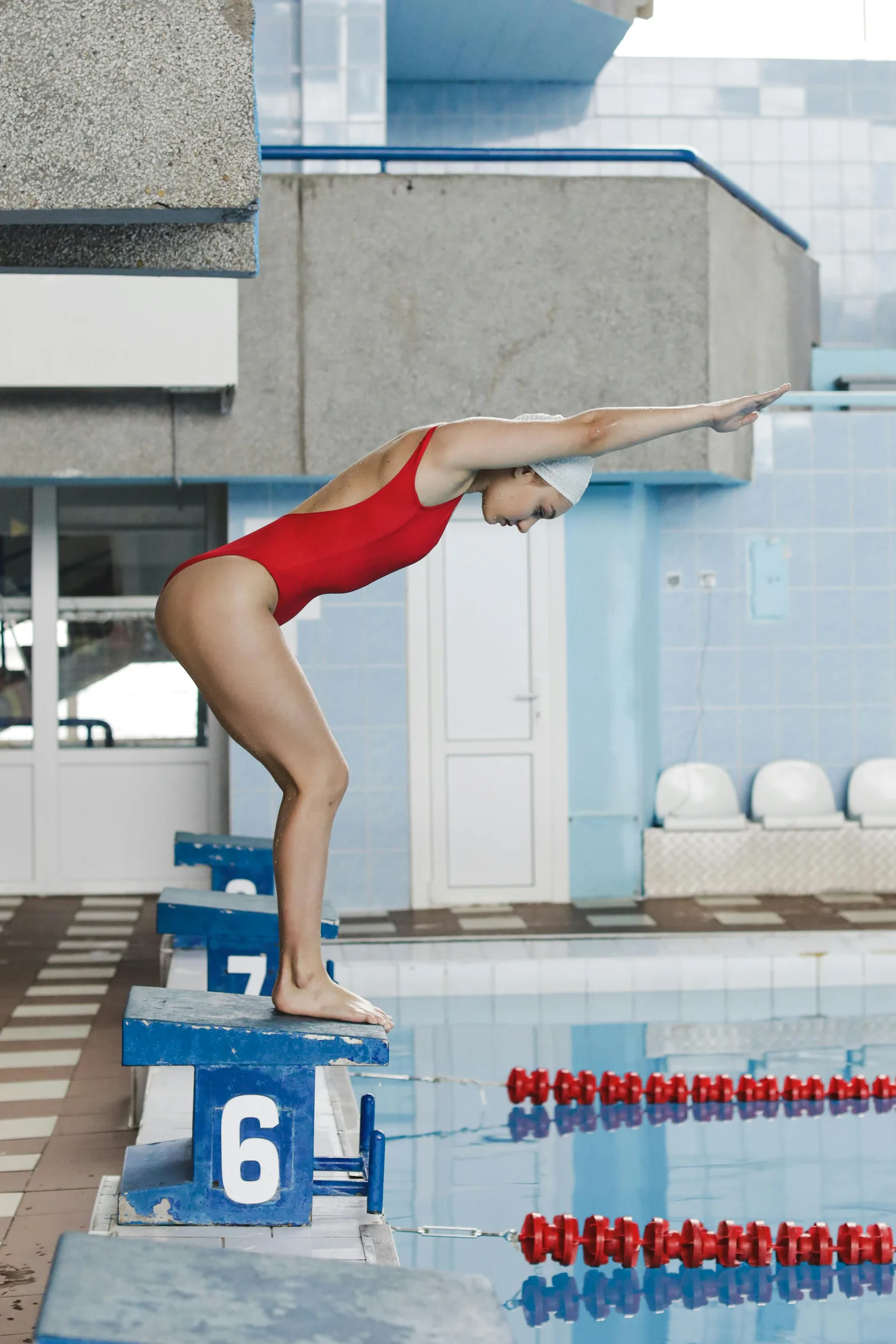
The minimum pool depth for 3-metre springboard diving — the most commonly contested Olympic springboard event — is 4 metres (approximately 13 feet) according to World Aquatics specifications. This depth applies to the zone directly below and around the springboard tip and extends to the sides. A 3-metre springboard diver leaves the board at heights of up to 4–5 metres above the water when accounting for the jump height above the board, and enters the water at speeds of 28–35 km/h depending on the dive’s angle and rotation. The 4-metre depth provides safe deceleration clearance for standard competition dives. For pool designers, the 4-metre depth zone must extend a specific horizontal distance in each direction from the springboard tip (forward, backward, and to each side) — the deep zone is not just directly below the board but covers the range of entry points for different dives, including those with significant forward travel distance.
1-metre springboard: minimum 3.5 metres (11.5 feet)
The minimum pool depth for 1-metre springboard diving is 3.5 metres (approximately 11.5 feet) at the point directly beneath the board. The 1-metre springboard produces lower entry speeds than the 3-metre — typically 20–25 km/h for standard dives — and the corresponding depth requirement is proportionally reduced. For recreational pools with low diving boards (often 0.5–1 metre above the water surface), the minimum depth under the board varies by national guideline and pool operator policy, but UK guidance from Swim England and pool safety standards typically requires a minimum of 1.8 metres of water depth for recreational plunge diving and diving boards at leisure centres, with deeper requirements for higher boards. Most UK leisure centres no longer offer fixed diving boards at all — the reduction in competitive diving infrastructure at public pools over the past 30 years has made dedicated diving pools increasingly rare outside specialist venues. For UK pools with competitive diving facilities, purpose-built diving venues include Ponds Forge International Sports Centre in Sheffield, which has a dedicated diving pool with a 10-metre platform and 5-metre depth for national competition use.
Why Diving Pool Depth Matters — Physics, Safety, and UK Venues
The physics of pool depth and diver safety
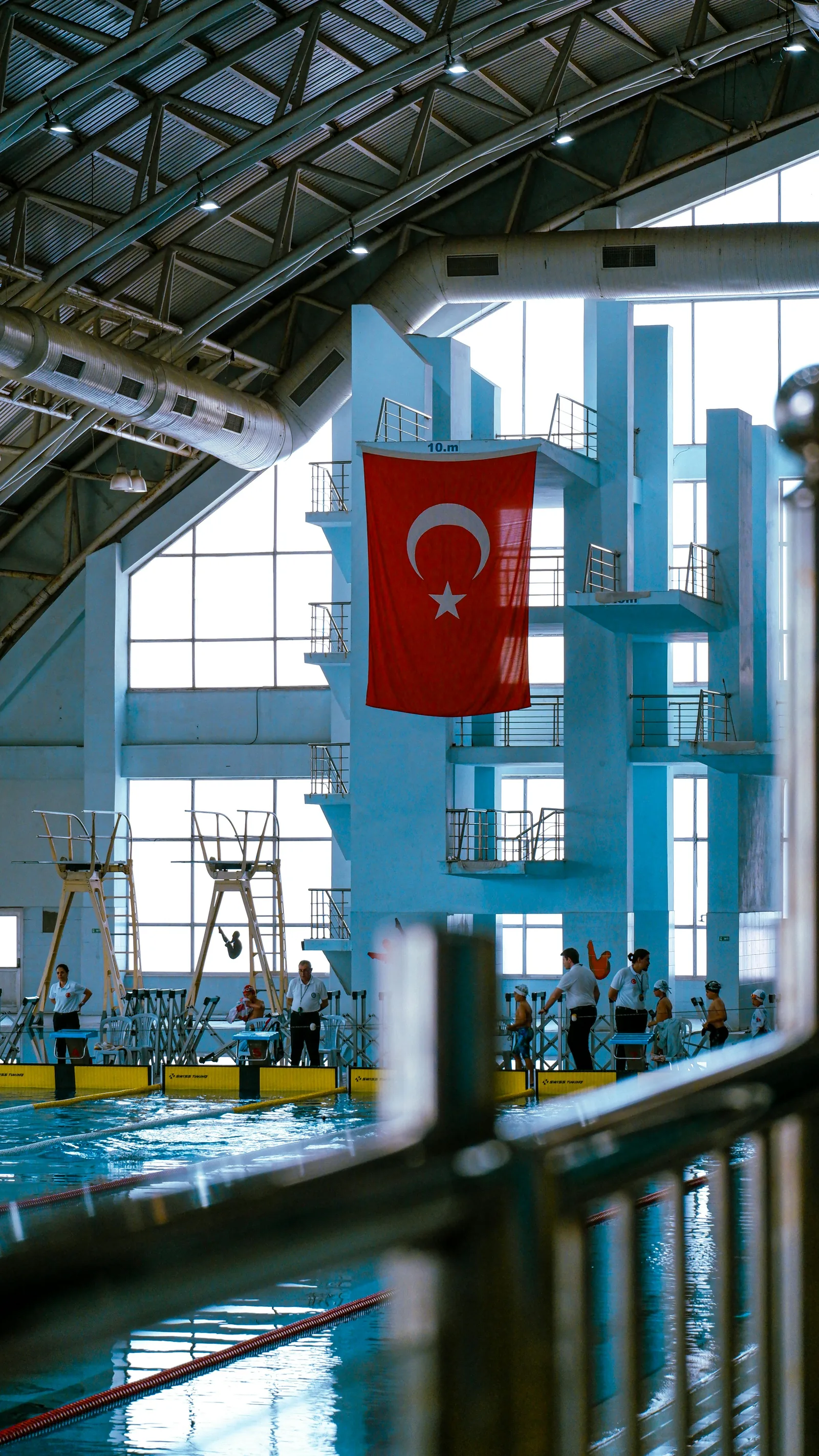
The relationship between diving height and required pool depth follows directly from physics. A diver dropped from height h metres reaches the water at a velocity of √(2gh) metres per second, where g is gravitational acceleration (9.8 m/s²). From 10 metres, this gives an entry velocity of approximately 14 m/s (50 km/h). To decelerate safely, the diver needs to lose this velocity within the pool depth — water resistance decelerates a streamlined entry at a rate depending on entry angle and body position, but the effective stopping distance for a head-first, straight-body entry from 10 metres is approximately 3–4 metres. The 5-metre minimum adds the required safety margin. From 3 metres, entry velocity is approximately 7.7 m/s (28 km/h) and the deceleration distance requirement is correspondingly shorter, accounting for the 4-metre minimum at 3-metre springboard height. Sport diving’s Wikipedia entry covers the physics of competitive diving entries in more detail, including the specific entry techniques that divers use to maximise safety at high-speed entries.
UK competitive diving pools and what depth they use
The UK has a small number of purpose-built diving pools meeting World Aquatics competition specifications. Ponds Forge in Sheffield (National Diving Centre) is the primary UK competition venue with a 10-metre tower and a pool depth that meets the 5-metre minimum. The Cardiff International Pool in Wales has diving facilities. Several university pools and regional facilities maintain 3-metre springboard capacity at 4-metre pool depth. Most leisure centre pools in the UK do not meet the depth requirements for any form of competitive springboard or platform diving — standard UK leisure pools are typically 1.0–1.8 metres at the shallow end and 1.8–2.0 metres at the deep end, which is insufficient for diving and is why diving boards are absent from most modern UK leisure centres. For those interested in learning to dive competitively, Swim England’s diving hub lists affiliated diving clubs and venues with appropriate facilities. Our guide to outdoor swimming pools and lidos across the UK covers publicly managed pool facilities broadly, while our article on how wave pools work covers the engineering and depth requirements for a different category of specialist pool.
Frequently Asked Questions
How deep is an Olympic diving pool?
Olympic diving pools must be a minimum of 5 metres (16.4 feet) deep — this is the World Aquatics (formerly FINA) requirement for pools hosting 10-metre platform competition. Most modern Olympic and World Championship venues exceed this minimum, with typical construction depths of 5.5–6 metres. The 5-metre minimum is set by the physics of safe deceleration: a diver from 10 metres enters the water at approximately 50 km/h and requires approximately 3–4 metres of water to decelerate safely, with the 5-metre specification providing the required margin.
How deep does a pool need to be for a diving board?
The required depth depends on the board’s height: 1-metre springboard requires a minimum 3.5 metres (11.5 feet) depth directly beneath the board; 3-metre springboard requires 4 metres (13 feet); 5-metre platform requires 4 metres; 10-metre platform requires 5 metres. These are World Aquatics competition specifications. UK leisure centres with recreational diving boards (typically 0.5–1 metre) require minimum water depths per the Swim England and Health and Safety Executive guidelines for public pool diving, which generally specify at least 1.8 metres for low-level diving boards.
How deep are diving pools in the UK?
Purpose-built UK diving pools at dedicated competition centres (Ponds Forge Sheffield, Cardiff International Pool) meet the 5-metre depth specification for 10-metre platform competition. Most UK leisure centre pools are not built to diving specification — standard depths of 1.0–2.0 metres do not support diving boards of any kind, which is why competitive diving boards are absent from the majority of public pools. The decline in diving board provision at UK leisure centres since the 1990s reflects both safety regulations and the cost of maintaining deep-water pools.
Why are diving pools so deep?
The depth is determined by the physics of entry speed and deceleration. Divers from the 10-metre platform enter the water at approximately 50 km/h — about the speed of a fast road vehicle. At that speed, a streamlined entry requires 3–4 metres of water to decelerate to safe velocity; the 5-metre minimum adds safety margin for entries that are not perfectly streamlined. Shallower water would mean the diver reaches the pool floor before fully decelerating, causing potentially serious injury. The higher the platform, the greater the entry speed and the deeper the water must be to provide safe stopping distance.